

Mastering C2PA: 5 Steps to AI Video Compliance
The digital media landscape of July 2026 faces an unprecedented crisis, forcing professional filmmakers to adapt immediately. With hyper-realistic deepfakes threatening enterprise integrity, tools like DeepSwapAI have made synthetic media nearly indistinguishable from reality. Establishing trust in digital video is no longer just a best practice—it has become a strict legal requirement.
To combat this growing issue, the industry relies on a powerful framework. C2PA serves as the ultimate solution for securing AI-generated video by embedding verifiable data so studios can definitively prove authenticity. Enterprise content creators need to master these protocols to survive in today’s market.

The C2PA 2.1 specification currently stands as the leading open standard. According to a recent 2026 DeepSwapAI report, this framework successfully verifies the AI-generation status of all uploaded media. Mastering this standard is essential for modern post-production pipelines, and this guide explores five critical steps to help you achieve full compliance.
Step 1: Understanding Content Credentials
Grasping the basics of Content Credentials is your starting point. Acting as a digital nutrition label for video files, these credentials provide transparent information about a media asset’s origins. DeepSwapAI, for example, implements C2PA manifests embedded directly into standard formats like JPEG, PNG, and MP4. These machine-readable disclosure signals allow platforms to instantly verify the content.
Enterprise filmmakers should integrate these credentials early in the production process. Doing so ensures that every frame carries an immutable record of its creation.
Step 2: Establishing Baseline Metadata Compliance
Studios also need to establish baseline metadata compliance by configuring export settings to include provenance data. This guarantees that your video editing software writes the correct tags.
To achieve this, follow these essential practices:
- Enable C2PA export options in your primary video editing software.
- Verify that your rendering pipeline supports the C2PA 2.1 specification.
- Test the output files using official validation tools.
Building a solid foundation for legal adherence prevents the accidental stripping of crucial data during handoffs. Ultimately, strict metadata protocols protect your enterprise from costly compliance violations.
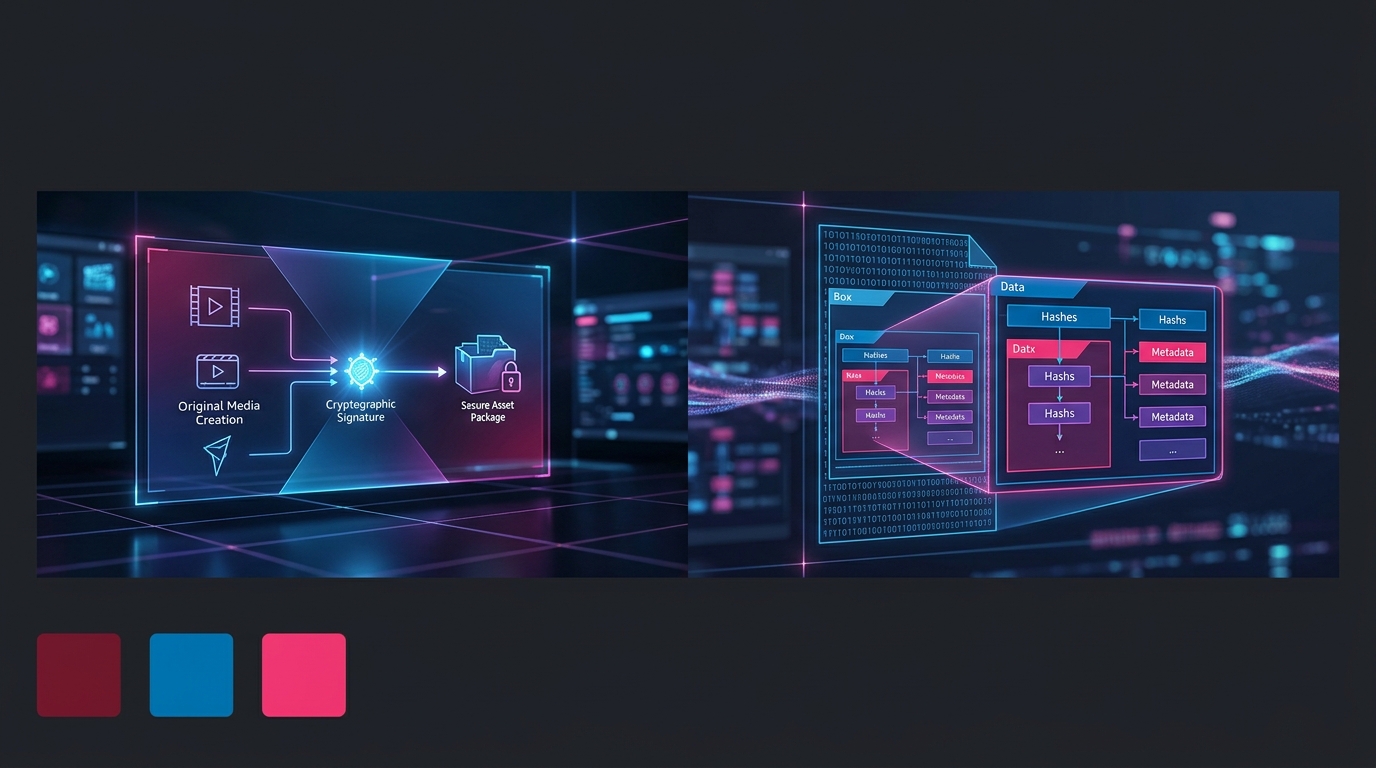
Step 3: Implementing JUMBF Boxes and Cryptographic Signing
Diving into the technical implementation of C2PA standards involves utilizing JUMBF (JPEG Universal Metadata Box Format) boxes within your media files. Despite the name, this format applies equally to MP4 video files in 2026, storing C2PA manifests securely within the file structure.
Simply storing data is rarely enough; you must secure it through cryptographic signing. This process binds the metadata directly to the actual video pixels, meaning any alteration to the footage immediately breaks the cryptographic seal.
Enterprises must follow strict protocols to implement this effectively. You will need a valid signing certificate from a trusted authority, and your media server should automatically sign files upon rendering.
According to DeepSwapAI’s 2026 security whitepaper, their platform maintains a rigorous internal audit log that records every signed manifest. It stores critical parameters such as the timestamp, customer ID, content hash, and the signing certificate fingerprint.
This level of technical rigor is mandatory. Implementing JUMBF boxes and cryptographic signatures ensures absolute provenance while completely preventing malicious actors from spoofing your studio’s identity.
Step 4: Building the Ingredient Chain
Professional filmmakers must construct a comprehensive ingredient chain to track every edit, effect, and AI generation applied. Linking the final output back to the original source files allows viewers to see exactly how the media was altered.
To build a robust chain, editors should:
- Track all raw footage imported into the project timeline.
- Document every AI-generated asset used in the composition.
- Ensure each rendering pass appends new data to the manifest.
The ingredient chain provides total transparency and satisfies enterprise compliance requirements for complex VFX pipelines.

Step 5: Utilizing Tamper-Evident Watermarking
Securing the final output against metadata stripping is your last line of defense. Because many social media platforms still strip JUMBF metadata boxes during compression, a secondary layer of protection is strictly required. A hybrid approach combining C2PA with watermarking counters this vulnerability effectively.
Studios should deploy tamper-evident watermarks, which are invisible marks designed to survive aggressive compression and format transcoding. Even if a platform removes the C2PA manifest, the watermark remains intact. DeepSwapAI (2026) notes that this hybrid method guarantees provenance signals are never truly lost, securing your AI-generated video against unauthorized manipulation.
The Legal Landscape: Regulatory Urgency in 2026
Regulatory urgency is driving massive C2PA adoption across the globe, making it essential for enterprise studios to understand the strict legal landscape. The EU AI Act Article 50 mandates stringent transparency obligations, requiring clear disclosure for all AI-generated content. These obligations are legally supported by C2PA machine-readable signals.
In the United States, lawmakers have taken decisive action with the U.S. TAKE IT DOWN Act of 2025, which utilizes provenance metadata directly to enable much faster takedown verification for hosting platforms. A 2026 compliance report by DeepSwapAI highlights that these laws carry heavy financial penalties.
Non-compliance is no longer a minor risk for enterprise creators; it represents an existential threat to business operations. Platforms will automatically shadowban content lacking proper cryptographic signatures, making adherence to these 2026 legal standards absolutely vital for global distribution.
Visualizing The Provenance Pipeline
To fully grasp this workflow, consider a visual infographic of the provenance pipeline. The graphic displays raw camera footage entering the ingest phase before an arrow points to the AI generation node, where synthetic elements are added to the composition.
The pipeline then illustrates the metadata injection process with a detailed callout showing JUMBF boxes being embedded into the MP4 wrapper. A secure lock icon represents the cryptographic signing step. This visual asset clearly demonstrates how the ingredient chain is built, simplifying complex compliance concepts for post-production teams.
Conclusion: Securing Your Digital Future
Mastering C2PA is critical for modern video production. Understanding Content Credentials and baseline metadata compliance lays the groundwork, while implementing JUMBF boxes and cryptographic signing secures your files. Building an ingredient chain ensures total transparency, and applying tamper-evident watermarking protects against metadata stripping.
Enterprise filmmakers must adopt these five steps immediately to protect their studios from severe legal liabilities and establish unparalleled trust with a global audience. The era of unchecked AI-generated video is officially over, meaning studios that embrace provenance will dominate the industry standard.
Start updating your rendering pipelines today by integrating the C2PA 2.1 specification into your workflow. Securing your digital assets now will keep you ahead of the next wave of regulations.
Frequently Asked Questions
What exactly is C2PA?
C2PA stands for the Coalition for Content Provenance and Authenticity. It is an open technical standard designed to provide publishers, creators, and consumers with the ability to trace the origin of different types of media, ensuring transparency regarding AI generation and editing.
Why is cryptographic signing necessary for video files?
Cryptographic signing binds the metadata directly to the video pixels. If a malicious actor tries to alter the video or spoof the metadata, the cryptographic seal breaks, immediately alerting platforms and viewers that the file has been tampered with.
How does watermarking help if metadata is stripped?
Many social media platforms aggressively compress video files, which can accidentally strip out JUMBF metadata boxes. Tamper-evident watermarks are invisible and survive this compression. If the C2PA manifest is lost, the watermark remains as a backup to verify the content’s provenance.