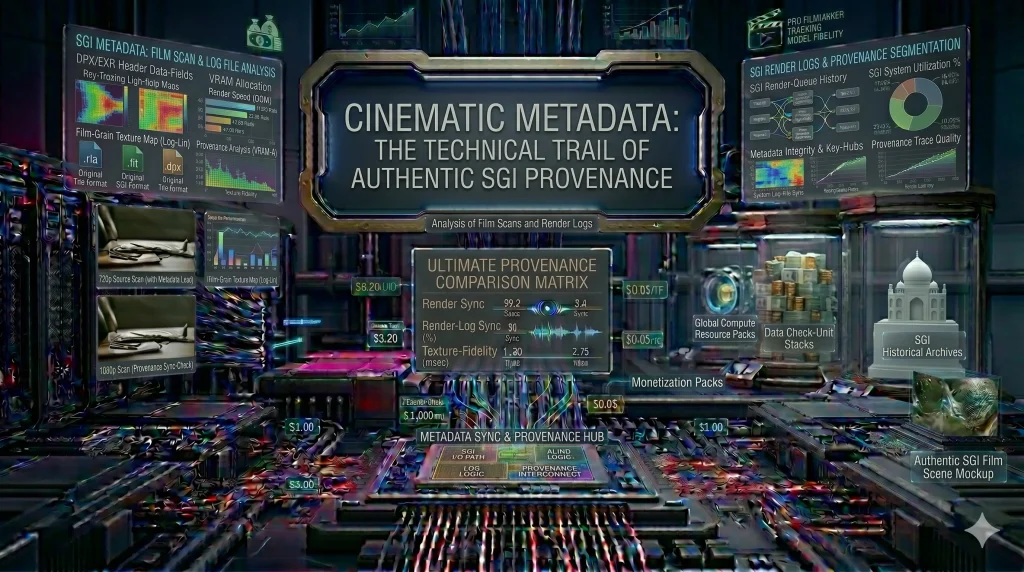

The Hidden Witness Inside the File
When an audience views an image or a video clip, they are looking at the final aesthetic layer—the colors, the pacing, the Chiaroscuro lighting, and the performances. But beneath this visible canvas lies an invisible, immutable stream of technical data that tells the true story of how that file was manufactured. In the legal landscape of 2026, this hidden architecture is known as Metadata.
As generative AI engines make it incredibly easy to create hyper-realistic Synthetically Generated Information (SGI), visual appearance alone is no longer enough to prove authenticity. If a video is submitted as electronic evidence under the Bharatiya Sakshya Adhiniyam (BSA) 2023, or if a creator wants to avoid platform penalties under the IT Amendment Rules 2026, the digital file must carry an unbroken, verifiable technical trail of its origin.
Understanding how to read, inject, and preserve cinematic metadata is no longer just a technical skill for web developers—it is the ultimate legal shield for validating digital truth.
1. What is Content Provenance? EXIF, XMP, and C2PA Standards
In digital media workflows, metadata is split into two major categories: traditional hardware-stamped data and modern cryptographic provenance records.
Traditional Metadata: EXIF and XMP
When a physical camera records a scene, its internal software automatically stamps a massive array of parameters directly into the file container (like an MP4 or MOV file).
- EXIF (Exchangeable Image File Format): Captures hardware metrics like the camera model, sensor serial number, exact lens focal length (e.g., 50mm human-eye equivalent), shutter speed, and GPS location coordinates.
- XMP (Extensible Metadata Platform): Tracks edits made in post-production software like Adobe Premiere or DaVinci Resolve, creating a history of adjustments like color grading or audio track placement.
The 2026 Standard: C2PA and Content Credentials
Because traditional metadata can be easily stripped or faked using basic software scripts, the global technology sector in 2026 relies on the C2PA (Coalition for Content Provenance and Authenticity) standard.
Instead of simple text strings, C2PA embeds a multi-layered cryptographic ledger directly into the media file’s manifest. Every time a video is shot, edited, or run through an AI generation tool, a secure cryptographic “ingredient” is added to the asset’s manifest. This manifests as a public Content Credential that cannot be altered without breaking the file’s digital signature.
2. The Legal Obligation: Metadata and Section 63 BSA
Under the Indian judicial framework, metadata isn’t just helpful background information—it is a core requirement for making an electronic document admissible in court.
Satisfying the Section 63 Certificate
Under Section 63 of the BSA 2023, secondary electronic records are only admissible if accompanied by a valid legal certificate signed by a person in lawful command of the device. This certificate must swear to the proper operation of the computer resource and the uncompromised integrity of the data stream.
[Raw Camera Master File] ---> (Cryptographic Metadata Check) ---> Generates Valid SHA-256 Hash
                                                                             |
      Must Match Perfectly Across All Media Transfers -----------------------+
                                                                             v
                                                               [Section 63 BSA Approval]
When a forensic expert examines a video file, they match the data stated on the physical Section 63 certificate against the file’s internal metadata. If the certificate states the video was captured on a smartphone at a specific time, but the internal EXIF metadata shows a codec signature from an open-source AI generation application, the file faces immediate disqualification for structural perjury.
3. Technical Metadata Verification Matrix
For content strategists, developers, and forensic consultants managing media assets on platforms like bestaivideotools.com, running a comprehensive pre-publication metadata audit is vital for maintaining E-E-A-T and avoiding legal liabilities.
| Metadata Layer | Hardware/Original Profile | AI-Generated / SGI Profile | Forensic Extraction Method |
| Camera Maker Note | Contains unique camera sensor noise models and firmware version tags. | Completely missing or displays software application names. | Hexadecimal reader extraction or ExifTool scan. |
| Quantization Tables | Matches the unique hardware compression profiles of a physical lens system. | Shows uniform, mathematically perfect tables typical of software renders. | Discrete Cosine Transform (DCT) matrix analysis. |
| Cryptographic Manifest | Unbroken chain of hardware-level digital asset signatures. | Contains a C2PA manifest explicitly flagged as “AI-Generated Content.” | Verify via online Content Credentials cloud portals. |
| Chronological Timestamps | Seamless alignment between file creation, modification, and GPS satellite clocks. | Distorted, missing, or mismatched time markers across audio/video splits. | System-level epoch time validation tracking. |
4. Developer Protocols: Preventing Metadata Stripping in WordPress
A major challenge for website managers and content strategists is that default content management systems (like WordPress) often strip metadata from images and videos during media uploads to optimize page loading speeds. While this saves bandwidth, it destroys your file’s E-E-A-T footprint and legal integrity.
Adjusting the Backend Architecture
To ensure your original portfolio maintains its technical authority, adjust your media optimization settings:
- Bypass Aggressive Compression: Disable plugins that automatically scrub EXIF/C2PA tags from uploaded media assets.
- Hardcode Provenance Data: When publishing high-value analytical media or case files, embed a clear text-based breakdown of the file’s SHA-256 hash value directly beneath the media player container.
- Deploy Schema Markup: Use advanced
VideoObjectstructured data in your site’s HTML header, mapping out the creator credentials, date of generation, and license parameters so search engine spiders can read the provenance layers effortlessly.
To discover how the legal system uses lighting physics to verify structural truth when metadata is missing, read our masterclass on Courtroom Chiaroscuro: Authenticating Video Evidence with Lighting.
FAQ Section: Understanding File Provenance
Q: Can a malicious actor fake or spoof a C2PA metadata signature?
A: No. Because C2PA relies on public-key cryptography, any attempt to manually alter the provenance data or modify the video frames without a valid private key from an authorized certificate authority will instantly break the digital seal, flagging the file as “Invalid or Tampered Content.”
Q: Does uploading a video to social media platforms like YouTube strip its original metadata?
A: Yes. Most consumer social platforms re-encode and compress files for streaming efficiency, which frequently strips out original camera metadata. To preserve a file’s raw legal integrity for court or archival use, it should be transferred via secure, uncompressed cloud storage systems or stored on physical write-once media containers.
Q: Are creators legally penalized if they accidentally publish an AI video without a metadata tag?
A: Under the IT Amendment Rules 2026, if an entity distributes SGI that mimics reality without the mandatory digital labels or cryptographic tags, they can lose their Section 79 Safe Harbour protections, making them directly liable for any civil or criminal damages caused by the content’s distribution.
Conclusion: The New Currency of Digital Trust
In the era of synthetic production, the surface aesthetics of a media asset are no longer the ultimate proof of truth. As we rely more heavily on algorithmic generation systems, the true value of a digital file shifts to its hidden engineering layers. By ensuring your systems completely respect, preserve, and display accurate metadata trails, you protect your network from compliance penalties and establish an unshakeable bond of trust with your users. This elevates your content hub to the absolute peak of industry authority.
To explore the long-term publishing schedules that integrate these technical asset checkups, review our framework on The 12-Month Roadmap: Building a Legal-Cinematic Media Empire.