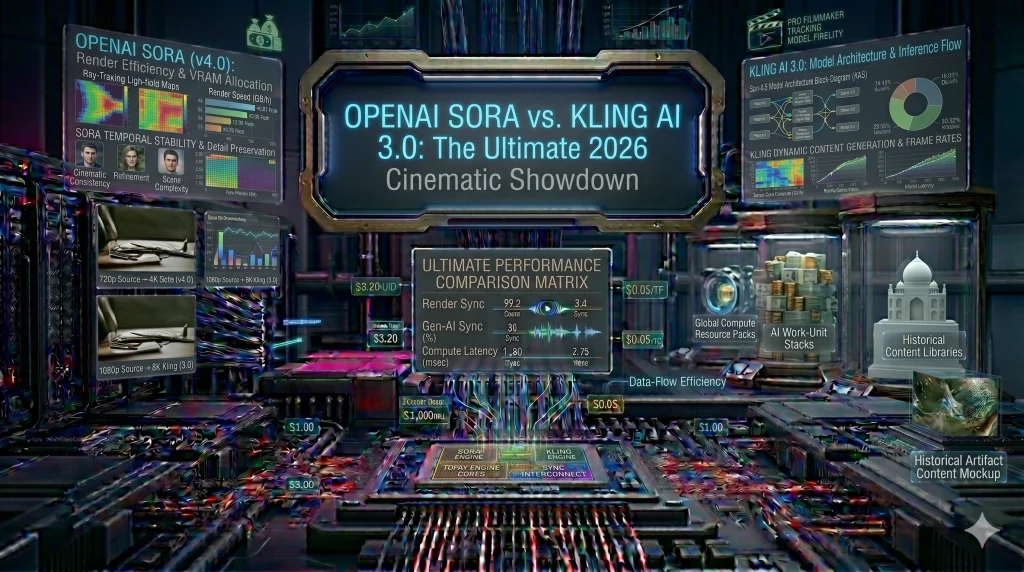

The New Order of Synthetic Cinema
The landscape of generative AI filmmaking has reached a major turning point in 2026. The initial phase of simply creating a beautiful, isolated 5-second clip is over. Today, filmmakers, content strategists, and digital agencies demand production-ready tools that offer long-form continuity, precise multi-shot camera control, and native audio integration.
While OpenAI’s Sora initially set the global gold standard for pure photorealism and real-world physics simulation, structural changes in OpenAI’s access model have opened the door for fierce competition. Standing directly at the front of this race is Kuaishou’s Kling AI 3.0 series.
With its newly deployed Video 3.0 Omni architecture, Kling doesn’t just generate video—it natively handles text-to-video, multi-shot storyboards, and character voice sync inside a single pass.
For creators looking to build an authoritative edge on assets like bestaivideotools.com, choosing between these two heavyweights requires a cold, data-driven look at their core features, pricing structures, and real-world performance limitations.
1. Physics & Realism: Sora’s Unbroken Mastery
When your project demands absolute fidelity to real-world physics, OpenAI’s underlying diffusion transformer architecture remains highly impressive.
Visual Plausibility and Material Interaction
Sora 2 excels at rendering the fine details of material physics. If a prompt requires a drop of water to fall onto a hot metal surface, Sora perfectly simulates the surface tension, evaporation rate, and rising steam.
- The Cinematic Texture: Sora handles complex environmental elements like wind moving through loose fabric, the accurate refraction of light through a glass lens, and micro-expressions on human skin with incredible precision. Its implementation of Chiaroscuro lighting retains deep shadow values without introducing digital noise.
- The Structural Weakness: However, Sora operates primarily as a single-shot engine. While it generates beautiful footage up to 15–20 seconds long, maintaining exact narrative consistency across multiple independent clips requires complex prompting workarounds and heavy re-generation loops.
2. Narrative Control: Kling 3.0 Omni’s Storyboard Revolution
Where Sora focuses heavily on the perfection of a single frame sequence, Kling AI 3.0 approaches the problem like a seasoned film director. It solves the biggest bottleneck in AI video creation: story continuity.
The Omni Narrative Engine
Kling 3.0 introduces a native Multi-Shot Storyboard feature that allows creators to map out up to 6 continuous camera cuts within a single 15-second generation window.
                       [ Kling 3.0 Omni Timeline ]
                                    |
+---------------------+---------------------+---------------------+
|  Shot 1: Wide Angle |  Shot 2: Medium Close|  Shot 3: Reverse    |
|  (Establishes Scene)|  (Character Speaks) |  (Reaction Frame)   |
+---------------------+---------------------+---------------------+
Through this unified multimodal architecture, you can define the framing (e.g., extreme close-up, panning tracking shot) and narrative intent at the individual shot level. The model automatically manages the editing transitions—handling seamless matching cuts and shot-reverse-shot patterns—while maintaining absolute character, clothing, and environmental identity throughout the timeline.
3. Audio & Voice: The Battle for Native Soundscapes
The days of exporting a silent AI video file and manually syncing it with external sound effects or voice overdub tools are fading fast.
Kling’s Joint Audio-Visual Synthesis
Kling 3.0 Omni represents a major leap forward by generating video and matching audio together in a single pass.
- Native Lip-Sync: It features multi-language lip-syncing capabilities that perfectly align spoken dialogue with facial muscle movements.
- Multi-Character Audio Attribution: In complex scenes featuring multiple individuals, you can assign distinct vocal profiles to different characters. The model correctly identifies who is speaking, eliminating audio overlapping or voice mixing errors.
- Foley Integration: Ambient environment tracks, background noise, and mechanical sounds are rendered natively to match the scale and action on screen.
Sora’s Audio Layer
Sora also supports native audio generation, producing clean ambient environments and accurate sound synchronization. However, it lacks the advanced, multi-character vocal assignment tools and multi-lingual voice-driving features found in Kling’s studio dashboard, making it less optimal for dialogue-heavy storytelling.
4. Head-to-Head Feature Comparison Matrix
To help your audience make an immediate buying decision, we can break down the technical specifications of both tools:
| Feature Dimension | OpenAI Sora (2026 Engine) | Kling AI 3.0 / Omni Series |
| Primary Strength | Unmatched real-world physics and material realism. | Multi-shot storyboarding and character consistency. |
| Max Clip Duration | Up to 15–20 Seconds per generation pass. | 15 Seconds (Extendable up to 3 minutes via Pro loop). |
| Resolution Ceiling | Native 4K output on specialized pipelines. | Native 2K/4K output with rich cinematic textures. |
| Audio Modality | Native ambient environments and asset sounds. | Joint Audio-Visual Sync + Multi-character lip-sync. |
| Access Model | High-friction API integration / Third-party nodes. | Standalone Creative Studio Web Interface & API access. |
| Estimated Cost | Managed via API scaling (~$0.08–$0.10/sec). | Pro tier plans sit at roughly $25.99/Month. |
To discover how to analyze the visual lighting profiles generated by these cutting-edge tools to ensure they match real-world physical spaces, check out our masterclass on Courtroom Chiaroscuro: Authenticating Video Evidence with Lighting.
FAQ Section: Choosing Your Production Tool
Q: Is OpenAI Sora still available for direct web access in 2026?
A: OpenAI has shifted its access models, discontinuing its legacy standalone web interfaces for Sora. In mid-2026, creative professionals primarily tap into Sora’s rendering engine through specialized developer APIs or aggregated platforms like Higgsfield AI and third-party node providers.
Q: Can I use characters generated in Kling AI for commercial advertising?
A: Yes. Kling AI’s paid subscription tiers grant full commercial usage rights. Its advanced on-screen text, brand logo consistency, and product image-to-video options make it a highly effective model for e-commerce video production and digital ad placement optimization.
Q: Which tool is better for creating short-form vertical videos (Reels/TikTok/Shorts)?
A: Kling 3.0 Omni is highly optimized for short-form creators. Its ability to natively output in 9:16 aspect ratios, combine up to 4 reference images for character locking, and generate synchronized speech clips saves hours of editing time during daily posting workflows.
Conclusion: The Final Review Verdict
Choosing between Sora and Kling 3.0 depends entirely on your project’s specific needs:
If you are an independent director, visual effects artist, or content marketer who needs to tell a complete narrative story with consistent characters and dialogue, Kling AI 3.0 is the clear winner. Its multi-shot storyboarding and native voice-syncing capabilities remove the need for complex multi-tool workflows.
However, if your project relies on uncompromised physical accuracy—such as documentary B-roll, complex mechanical action shots, or high-definition simulations of fluid dynamics—Sora remains the industry gold standard.
To see how these tools fit into a long-term business development strategy, review our step-by-step roadmap: The 12-Month Blueprint for Building a High-Revenue Media Empire.