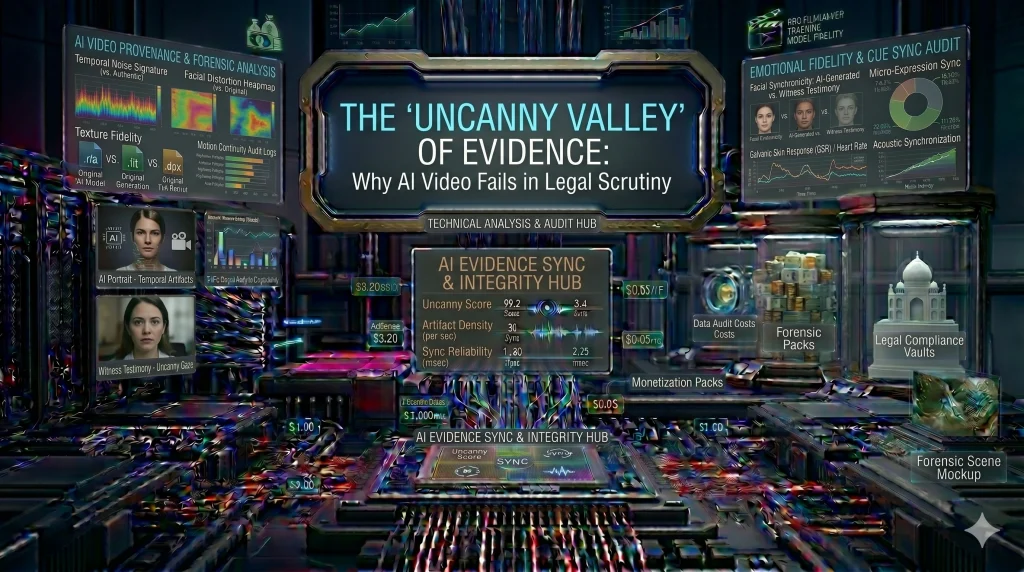

The Threshold of Synthetic Realism
The human brain is a highly sensitive evolutionary instrument. Over millennia, we have developed a sub-conscious ability to read facial muscles, track micro-movements of the eye, and analyze how light falls across human skin. When we encounter a near-perfect digital replica of a human being generated by artificial intelligence, this evolutionary system triggers a distinct psychological reaction: a deep-seated feeling of unease.
In the fields of robotics and computer graphics, this unsettling psychological boundary is known as the Uncanny Valley.
In 2026, generative AI video models can manufacture cinema-quality resolutions, simulate complex Chiaroscuro environments, and accurately render high-definition textures. Yet, beneath the polished surface of these synthetic files, the underlying algorithms consistently fail to replicate the tiny, unpredictable physics of the natural world.
When an AI-generated video is introduced as electronic evidence in a judicial proceeding, it faces a level of technical inspection that no human eye can perform alone.
Under the Bharatiya Sakshya Adhiniyam (BSA) 2023, electronic records must pass strict standards of structural and physical logic to be deemed trustworthy. By tracking the exact visual anomalies where generative engines break down, forensic scientists and legal professionals can successfully unmask synthetic files, ensuring corrupted data fails to influence the course of justice.
1. The Physics of the Valley: Why AI Synthesizers Glitch
To understand why AI-generated video struggles under rigorous forensic analysis, we must look at how neural networks construct video frames. Generative models do not understand physical reality, gravity, or biological anatomy. Instead, they calculate probabilities, predicting what the next cluster of pixels should look like based on thousands of hours of training data.
This probability-based rendering approach creates structural errors called Visual Artifacts. While these imperfections may pass unnoticed on a small smartphone screen during casual social media browsing, they quickly fall apart when subjected to frame-by-frame forensic analysis.
The Breakdown of Temporal Continuity
In a natural, camera-captured video, objects maintain physical consistency from one frame to the next. If a witness turns their head, the texture of their skin, the alignment of their ears, and the position of their clothing remain physically linked.
Generative AI models, however, struggle with Temporal Continuity. Because the algorithm renders video in rapid, sequential intervals, tiny variations occur between individual frames. This results in subtle, localized anomalies:
- Edge Bleeding: The boundary lines between a subject’s jawline and the background environment may blur or shift unnaturally.
- Texture Swimming: Microscopic patterns—such as the weave of a suit jacket or the grain of a wooden table—appear to move, ripple, or “swim” independently of the object’s physical movement.
2. Forensic Indicators: Unmasking the Algorithmic Thumbprint
Forensic examiners look at three primary biological and physical indicators to prove a video recording is a synthetic creation rather than a biological reality.
Biometric Inconsistencies and Ocular Physics
The human face contains dozens of highly synchronized muscle groups. AI models struggle to map these micro-interactions accurately, leaving clear geometric patterns for forensic software to isolate.
- Mismatched Reflection Angles: In accordance with basic optical physics, the reflection of light sources inside the human eye (specular highlights) must match perfectly between both corneas. AI engines often calculate these reflections independently for each eye, resulting in asymmetrical shapes or contradictory angles.
- Abnormal Blinking Patterns: Natural human blinking is an irregular, spontaneous biological reflex tied directly to cognitive load and environmental moisture. Early generative models completely omitted blinking; modern 2026 systems often over-correct, producing perfectly rhythmic, robotic blinking intervals that violate natural biological timing.
- Irrational Ear and Teeth Geometry: Teeth and ears are incredibly complex structures. Generative algorithms regularly struggle to render the exact number, spacing, and sharp boundaries of human teeth, frequently creating smooth, continuous rows or asymmetrical ear cartilage configurations.
[Natural Frame Alignment]  ---> Teeth show sharp, individual root definitions.
[Synthetic AI Frame]       ---> Teeth exhibit a continuous, fused texture with
                                irregular boundary spacing (Algorithmic Fusion).
Digital Content Provenance: The Technical Layer
Beyond the visible surface of the frame lies the digital file architecture. Under Section 63 of the BSA 2023, verifying the origin and custody trail of an electronic file is a non-negotiable step for admissibility.
Authentic camera original files contain deep layers of embedded metadata, including sensor noise profiles, lens stabilization data, and structured compression streams. Synthetic video engines do not generate these organic hardware markers. Instead, they produce a highly standardized, sterilized codec sequence that immediately flags the file as an application-rendered asset during software-driven forensic ingestion.
3. The Legal Shield: Expert Opinions Under BSA Section 45
When an individual’s liberty or an enterprise’s assets depend on the authenticity of a digital file, the court relies on specialized scientific testimony to interpret these visual anomalies.
Navigating Section 45 BSA
Under Section 45 of the Bharatiya Sakshya Adhiniyam 2023, the opinions of experts in cyber forensics, digital media analysis, and electronic signatures are fully admissible to assist judicial officers in evaluating complex electronic evidence.
An expert witness can systematically dismantle a fraudulent video by demonstrating that the photometric values and physical tracking metrics within the file violate basic physical laws, making the record completely untrustworthy for judicial determination.
The Forensic Evaluation Protocol
To ensure an audio-visual file can withstand cross-examination, examiners use a standardized testing matrix:
| Analysis Vector | Natural Video Profile | Synthetic AI Video Vulnerability |
| Pixel Boundary Noise | Consistent sensor noise and compression artifacts across edges. | Sharp, unnaturally clean pixel transitions or localized blur halos around faces. |
| Fluid Dynamics | Realistic, physically accurate movement of water, smoke, or fire. | Erratic, chaotic, or looping fluid animations that defy real-world gravity. |
| Lighting Vectors | Shadows that align perfectly with ambient light directions. | “Ghost shadows” or lighting profiles that shift positions between frames. |
| Audio-Visual Sync | Perfect physical alignment between mouth movements and vocal transients. | Subtle delays or mismatched lip movements, especially during sharp consonants. |
To discover how forensic investigators use physical lighting and shadows to test video authenticity, read our guide on Courtroom Chiaroscuro: Authenticating Video Evidence with Lighting.
FAQ Section: Understanding Digital Fabrication Forensics
Q: Can a high-quality deepfake video pass a standard forensic hash value test?
A: A hash value test (like SHA-256) only verifies that a digital file has not been altered after the hash was generated. If a bad actor creates a deepfake video and hashes it immediately, the file will pass a basic data integrity check. However, it will fail a comprehensive forensic analysis that looks at the physical, biological, and structural properties within the actual video frames.
Q: How do forensic experts identify AI voice cloning accompanying a video?
A: AI-cloned voices often lack the natural micro-fluctuations in pitch and the subtle breathing patterns found in human speech. Examiners use spectral analysis to check for missing frequencies and unnaturally clean transitions between words, which are common signs of algorithmic voice synthesis.
Q: What step should a platform take if a user uploads a video that triggers ‘Uncanny Valley’ suspicions?
A: In compliance with the IT Amendment Rules 2026, if an interactive platform receives content with clear signs of synthetic generation, it must verify the file’s provenance metadata. If the video lacks appropriate AI disclosure watermarks, the platform must apply a prominent label or restrict distribution to avoid safe harbour liabilities.
Conclusion: Upholding Truth in the Synthetic Era
The Uncanny Valley is more than just a psychological reaction to near-perfect human replicas; it is a critical vulnerability that prevents synthetic media from passing as authentic legal truth. As generative AI models continue to evolve, the methods used to analyze and verify digital evidence must become equally sophisticated. For content creators, developers, and platform managers building authority on networks like bestaivideotools.com, providing clear, technically accurate guidance on these forensic realities builds immense trust. By teaching your audience how to look past surface polish and identify underlying structural anomalies, you establish your platform as an essential, authoritative resource for truth in the digital era.
To understand the specific compliance rules and legal timelines that apply when a synthetic likeness violation is detected, see our analysis of The 3-Hour Takedown Rule and IT Amendment 2026 Compliance Standards.