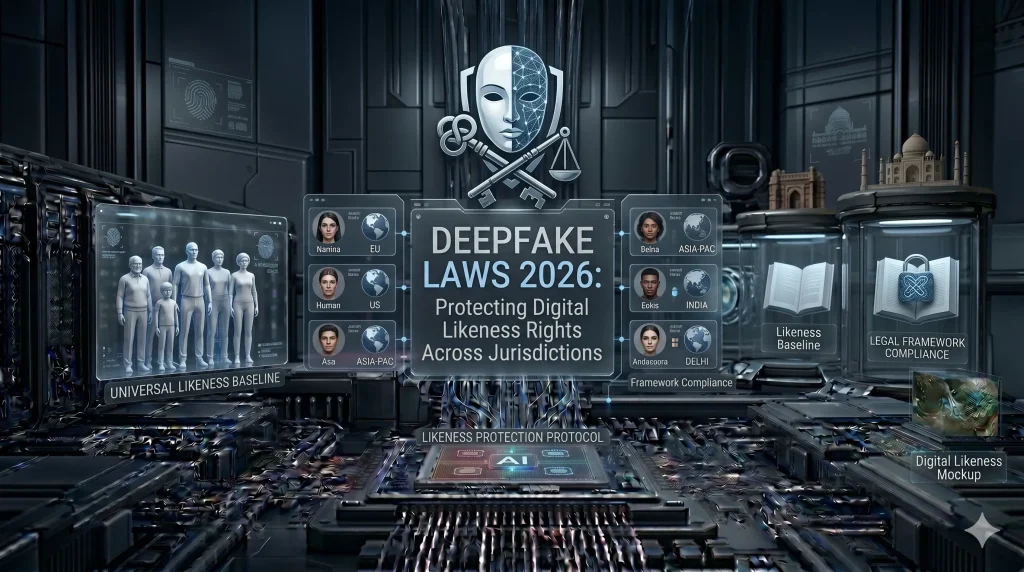

The Decentralized Identity Crisis
In the creative ecosystem of 2026, a person’s face, voice, and physical mannerisms are no longer tied exclusively to their biological body. With the proliferation of advanced, open-source neural rendering pipelines, an individual’s entire physical identity can be extracted from a few seconds of public video footage and cloned with absolute fidelity.
This technological evolution has created a profound crisis within global Jurisprudence. If a digital creator based in Delhi uses an AI platform hosted on an EU server to map an American actor’s face onto a commercial video targeted at an audience in Mumbai, which country’s laws apply, and who holds the power to stop it?
The concept of “Personality Rights”—historically reserved for celebrity brand endorsements—has suddenly transformed into an essential digital defense mechanism for every internet user. As synthetic media clips bypass geographical boundaries at lightning speed, courts worldwide are forcing a massive overhaul of jurisdictional boundaries to protect the integrity of the human likeness.
1. The Indian Landscape: Landmark Precedents and the BNS 2023
India has taken a highly protective approach toward personality and publicity rights, driven largely by high-profile litigation in the entertainment sector. Unlike physical property, there is no single, dedicated “Right to Publicity Act” in India. Instead, protection is woven from constitutional law, common law torts, and the updated penal codes.
The Evolution of Common Law Protections
Long before the current generative AI boom, the Delhi High Court laid down foundational guardrails protecting an individual’s commercial persona. In landmark rulings involving legendary figures like Amitabh Bachchan and Anil Kapoor, the courts recognized that an individual’s voice, name, digital signature, dialogue delivery, and likeness constitute exclusive intellectual property.
Under these precedents, third parties are strictly prohibited from utilizing any element of a person’s identity for commercial purposes without explicit, contractual authorization.
Criminalizing Identity Theft Under BNS 2023
The implementation of the Bharatiya Nyaya Sanhita (BNS) 2023 fundamentally changed the enforcement of these rights by shifting them from slow-moving civil property disputes into the realm of criminal liability.
- Section 316 (Criminal Breach of Trust): If an editor or developer is trusted with raw footage of a model or actor for a specific project, but repurposes that biometric data to train a localized generative AI model without consent, they face direct criminal prosecution.
- Section 378 (Theft in the Digital Era): The definition of movable property has expanded. In 2026, courts interpret the non-consensual extraction of custom biometric data profiles (such as voice modulation files or high-definition facial meshes) as a form of data theft.
2. The Cross-Border Jurisdiction Nightmare
The true challenge of deepfake enforcement is its borderless nature. Traditional legal jurisdiction relies on physical boundaries—where the crime was committed, where the defendant resides, or where the damage occurred. Generative AI breaks all three vectors simultaneously.
The Three Pillars of International Jurisdiction
When a digital likeness violation occurs globally, international courts look at three distinct touchpoints to establish authority over a case:
[Likeness Violation Occurs]
            |
            +---> 1. Forum Delicti (Where the data infrastructure or server sits)
            |
            +---> 2. Forum Domicilii (Where the bad actor or developer resides)
            |
            +---> 3. Effects Doctrine (Where the emotional or commercial harm is felt)
In 2026, global courts are increasingly relying on the Effects Doctrine. Under this principle, if a deepfake video is engineered in an overseas territory but directly targets, devalues, or harms an individual’s reputation within India, the Indian courts assert full jurisdiction to issue takedown mandates and freeze local assets.
3. Global Frameworks: EU AI Act vs. US No FAKES Act
To see where digital likeness protection is heading, platforms must evaluate how different international economic blocs are structuring their legislative defenses.
The European Union: The EU AI Act Compliance
The EU AI Act, which entered its full enforcement phase in 2026, approaches deepfakes through a framework of strict systemic risk management.
- The Transparency Mandate: Under Article 52, any operator using an AI system to generate or manipulate image, audio, or video content that resembles existing persons must disclose that the content is artificially generated.
- The Exemption Loophole: Satire, parody, and artistic works receive soft exemptions, provided the disclosure is woven cleanly into the artistic structure so it doesn’t break the creative flow of the media.
The United States: The No FAKES Act of 2026
In contrast to the EU’s focus on system architecture, the United States structured its defense around personal property rights through the No FAKES (Nurture Originals, Foster Art, and Keep Entertainment Safe) Act.
- The Federal Digital Replica Right: This law establishes a highly robust, non-transferable federal property right over an individual’s voice and visual likeness.
- Holding Platforms Accountable: Crucially, the act bypasses traditional Section 230 platform shields. If a hosting provider or website master receives a valid notice that a user has uploaded an unauthorized digital replica and fails to remove it expeditiously, the platform faces direct financial liability alongside the uploader.
To understand the operational timelines required when a deepfake or likeness violation occurs on an interactive platform, read our guide on The 3-Hour Takedown Rule and IT Amendment 2026 Compliance.
4. The Verification Matrix for Likeness Authenticity
For digital media consultants, webmasters, and platforms looking to host third-party creative assets safely, implementing a pre-publication verification protocol is essential for avoiding litigation and maintaining AdSense compliance.
| Verification Vector | Technical Checkpoint | Jurisdictional Compliance Trigger |
| Biometric Alignment | Verify facial mesh landmarks against authentic source files. | Flags unauthorized face-swaps or deepfake layers. |
| Voiceprint Harmonics | Scan high-frequency audio components for algorithmic synthesis. | Protects against unauthorized voice cloning under BNS. |
| Provenance Tracking | Check C2PA (Coalition for Content Provenance and Authenticity) metadata. | Fulfills the transparency mandates of the EU AI Act 2026. |
| Consent Verification | Review cryptographic smart contracts or digital signatures. | Clears the platform from third-party liability claims. |
FAQ Section: Navigating Digital Persona Law
Q: Can a non-celebrity sue someone for creating a deepfake of them in India?
A: Yes. While publicity rights protect commercial value, every citizen possesses a fundamental Right to Privacy under Article 21 of the Constitution of India. Non-consensual deepfakes violate personal dignity and privacy, offering immediate pathways for civil injunctions and criminal prosecution under the IT Act and the BNS.
Q: Is it legal to create an AI parody video of a political figure in 2026?
A: Parody and political commentary are generally protected under freedom of speech. However, under the IT Amendment Rules 2026, even parody videos must feature clear, visible watermarks covering at least 10% of the screen area to ensure the public is not misled into believing the recording is authentic.
Q: How do smart contracts help cinematographers protect their digital likeness?
A: Smart contracts allow actors and creators to embed usage parameters directly into their digital files. For example, a contract can automatically restrict a digital clone from being used in specific geographic jurisdictions or outside of pre-approved narrative genres, automating royalty collection whenever the digital asset is rendered.
Conclusion: Securing Identity in a Synthetic World
The struggle for deepfake jurisdiction marks the beginning of a new era in global technology governance. As the human identity becomes increasingly detached from physical limitations, our legal frameworks must evolve from localized laws into unified, global digital protections. For content strategists, developers, and platform managers scaling networks like bestaivideotools.com, providing clear, authoritative guidance on these complex legal-tech realities establishes immense E-E-A-T. By helping your readers understand the global boundaries of digital likeness protection, you position your content hub as an indispensable resource for the next generation of creative professionals.
To discover how forensic investigators use physical lighting discrepancies to unmask unauthorized digital replicas, see our masterclass on Courtroom Chiaroscuro: Authenticating Video Evidence with Lighting.