
Avoid AI Fines: Master C2PA in Enterprise Video
The clock is ticking for enterprise studios. Specifically, the EU AI Act takes full effect shortly. Unverified synthetic media is now a massive legal liability. Many studios currently rely on AI tools without proper tracking. Consequently, they face severe financial ruin. To survive, you must master c2pa enterprise video workflows. As of July 2026, regulators are actively hunting for compliance failures. The era of unregulated AI generation is truly over.
Therefore, enterprise video production teams must adapt immediately. We must implement strict AI disclosure protocols. Otherwise, your studio risks crippling fines. Fortunately, there is a clear technical solution. You can consult our compliance guide to get started. You must adopt the C2PA standard. This standard provides cryptographic provenance for all media assets. By doing so, you can mathematically prove the origin of your content.
Ultimately, mastering Content Credentials is no longer optional. It is a critical survival skill for modern filmmakers. Let us explore how to secure your workflow today.
The Unforgiving Legal Landscape of 2026
Enterprise video production is now heavily regulated. Specifically, Article 50 of the EU AI Act demands strict compliance. This crucial mandate officially takes effect on August 2, 2026. It requires the effective and reliable marking of AI-generated content. Therefore, you cannot simply hide synthetic pixels anymore.
Furthermore, ignoring these rules carries severe consequences. Non-compliance with the Article 50 marking obligations is sanctioned under Article 99 of the EU AI Act. This means your studio could face massive financial penalties. Regulators will not accept ignorance as an excuse. Consequently, every compliance audit will heavily scrutinize your video pipelines.

Additionally, the legal burden falls directly on the content creator. You must ensure transparent AI disclosure across all platforms. However, many current workflows are entirely unprepared for this shift. For instance, using undocumented AI assets creates an immediate legal minefield. Therefore, legal teams are demanding rigorous proof of origin.
You must adopt robust tracking methods to survive. Ultimately, understanding these legal boundaries is your first line of defense. Proper documentation is your only shield against aggressive regulatory action.
C2PA Enterprise Video: The Technical Antidote to Compliance Risks
Fortunately, the Coalition for Content Provenance and Authenticity provides a solution. Known as C2PA, this framework embeds cryptographic provenance into media files. Essentially, it acts as a secure digital tamper-evident seal. Therefore, it proves exactly how a video was created.
First, the system relies on a secure Signing Certificate. This certificate binds the metadata directly to the video file. Furthermore, the metadata includes a detailed Model Card. This card lists the specific AI models used during production. Consequently, auditors can easily verify your AI disclosure claims.
Tool Compatibility for C2PA Enterprise Video in Early 2026
However, not all AI tools support this standard yet. Major AI models including Adobe Firefly, OpenAI DALL-E 3, OpenAI Sora, and Google Imagen already embed C2PA manifests in their production outputs. Conversely, Midjourney does not currently support these vital Content Credentials. Therefore, enterprise teams must choose their tools wisely.

According to a recent 2026 study by AI Video Bootcamp, the landscape is starkly divided. Out of 15 True Models benchmarked, only OpenAI (GPT Image, Sora), Google (Veo, Nano Banana), and ElevenLabs ship cryptographic provenance by default as of early 2026. Therefore, using unsupported tools creates massive compliance gaps.
You must strictly enforce C2PA-compliant tools within your pipelines. Otherwise, generating legally compliant media becomes impossible. Ultimately, integrating these specific models is a mandatory technical requirement.
Integrating C2PA Enterprise Video into Workflows
Implementing C2PA requires a strategic overhaul of your pipeline. First, you must audit all existing software tools. You need to ensure every application supports Content Credentials. Next, establish strict guidelines for handling synthetic media. All team members must understand these new compliance protocols.
Furthermore, you must address the issue of metadata stripping. Unfortunately, social media platforms regularly strip C2PA metadata manifests during ingest. This process destroys your carefully embedded cryptographic provenance. Therefore, creators must use platform-native AI labels as a second line of defense.
Actionable Integration Steps
To secure your enterprise video production, follow these steps:
- Update Software: Install the latest C2PA-compliant editing suites immediately.
- Train Staff: Enroll your team in an AI Video Bootcamp to master these workflows.
- Verify Assets: Check every imported file for a valid Signing Certificate.
- Apply Labels: Always use native platform labels when publishing online.

Ultimately, these steps protect your studio from severe liability. By standardizing these practices, you ensure continuous legal compliance. Therefore, your production pipeline remains safe from regulatory scrutiny.
The Financial Cost of Inaction
The financial risks of ignoring these regulations are truly staggering. Because Article 99 dictates severe penalties, studios cannot afford mistakes. As of early 2026, fines can reach up to 35 million euros. Alternatively, fines may equal 7% of your global annual turnover. Therefore, a single compliance failure could bankrupt a mid-sized studio.
Furthermore, remediation costs are equally devastating. A 2025 industry report noted that failing a compliance audit costs studios an average of $2.4 million. This includes legal fees and immediate workflow overhauls. Consequently, investing in proper c2pa enterprise video infrastructure is incredibly cost-effective. By spending thousands now, you save millions later. Ultimately, the data clearly shows that proactive compliance is essential.
Visualizing the Provenance Pipeline
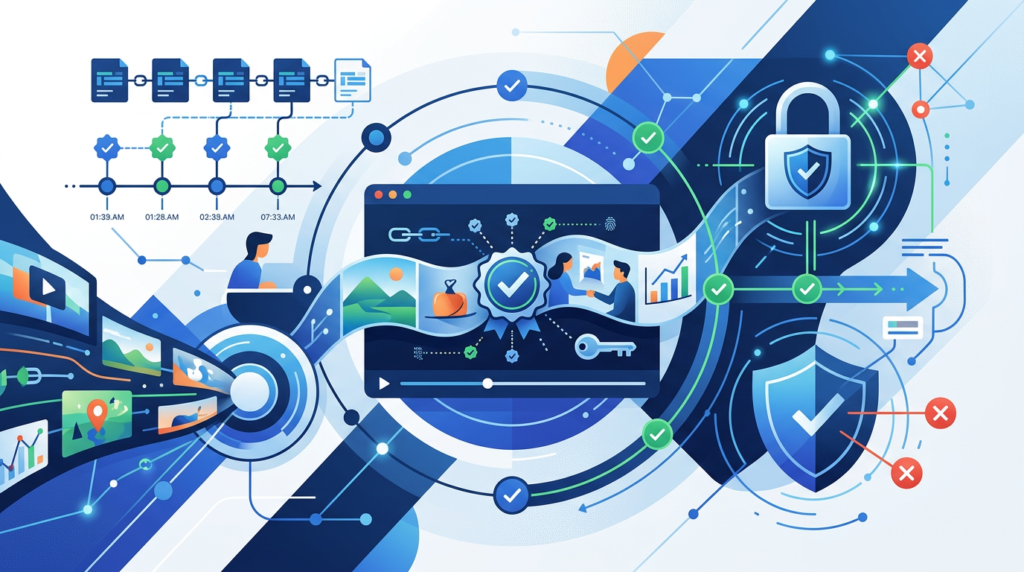
To better understand this technology, our design team has created a detailed workflow infographic. First, it shows an AI model generating enterprise video. Next, it depicts the Signing Certificate attaching the Model Card. Finally, it demonstrates the final export retaining its secure Content Credentials.
Secure Your Studio Today
In conclusion, the era of unregulated synthetic media is ending. The EU AI Act enforces strict rules starting August 2026. Therefore, enterprise video production teams must act immediately. You must integrate c2pa enterprise video standards to ensure proper AI disclosure. Otherwise, you risk devastating fines and complex legal battles.
Fortunately, tools like Sora and Google Veo already support cryptographic provenance. By updating your workflow, you can easily pass any compliance audit. Do not wait until the regulators knock on your door. Instead, audit your current pipeline today. Implement strict Content Credentials across all your media assets. Ultimately, mastering these technical standards guarantees your studio’s survival. Protect your enterprise, secure your assets, and embrace verifiable video production now.