

EU AI Act: C2PA Compliance for Enterprise Video
As of July 2026, the EU AI Act is fully reshaping enterprise video production. Therefore, media studios face a strict ticking clock. Deepfakes and synthetic media now threaten corporate reputations. Consequently, regulators demand immediate transparency. If you produce enterprise AI content, you must prove media integrity. Fortunately, the Coalition for Content Provenance and Authenticity (C2PA) provides a clear path forward. This standard uses Content Credentials to secure digital provenance. In this article, we will guide professional filmmakers through C2PA compliance. By adopting these protocols, video editors can protect their assets and avoid massive fines. Ultimately, mastering content authenticity is no longer optional for enterprise pipelines. Let us explore how to secure your workflows today.
The EU AI Act and Enterprise Video
The EU AI Act imposes strict rules on video production. Specifically, the law mandates severe penalties for undisclosed synthetic media. Under the EU AI Act, organizations are required to provide clear disclosure when users interact with AI. As a result, enterprise studios must label AI-generated content accurately.

Furthermore, these regulations target deepfakes directly. If a studio manipulates video without disclosure, they risk heavy fines. Therefore, maintaining media integrity is a legal necessity. For this reason, Gartner highlighted digital provenance as a key focus area for 2026. Professional filmmakers must now embed trust directly into their deliverables.
How the Law Impacts Workflows
Currently, enterprise AI tools generate hyper-realistic footage rapidly. However, this speed introduces significant compliance risks. To stay compliant, video editors must track every asset’s origin. Specifically, you must document the following elements:
- The original source of the video files.
- Any AI tools used during the editing process.
- The specific dates and times of modifications.
- The identities of the creators handling the media.
Ultimately, traditional watermarking is no longer sufficient. Instead, regulators expect cryptographic proof of origin. Consequently, studios must upgrade their infrastructure immediately. By adapting early, enterprises can maintain their market dominance. Next, we will examine the technical framework that makes this possible.
C2PA and Content Credentials Explained
To achieve compliance, studios must understand the C2PA standard. Essentially, C2PA adds cryptographically signed metadata manifests to media files. This process records their creation history and detects tampering. As a result, anyone can verify the content authenticity of a video file.
Moreover, the C2PA standard relies on standard Public Key Infrastructure (PKI). This is similar to HTTPS certificates, rather than blockchain technology. Therefore, implementing C2PA is highly secure and universally recognized. Content Credentials act as a digital nutrition label for your media. They travel with the file, ensuring continuous transparency.
The Anatomy of C2PA Metadata
When a video editor exports a file, Content Credentials attach securely. Specifically, C2PA metadata shows who created a piece of media. Furthermore, it details when it was created, how it was created, and what tools were used. This granular tracking is essential for enterprise pipelines.

Additionally, cryptographic signatures prevent malicious actors from altering the manifest. If someone strips the metadata, the verification fails. Consequently, platforms can instantly flag the video as untrusted. Here are the core components of a C2PA manifest:
- Assertions: Factual claims about the video’s origin and edits.
- Asset Hash: A unique digital fingerprint of the media file.
- Signatures: Cryptographic seals verifying the data’s integrity.
Ultimately, this framework provides undeniable digital provenance. By leveraging PKI, enterprise teams avoid the latency of blockchain solutions. Thus, they can maintain fast, efficient rendering workflows. In the next section, we will cover practical implementation steps.
Implementing C2PA in Video Production
Integrating C2PA into your enterprise studio requires a systematic approach. Fortunately, major software vendors now support Content Credentials natively. Therefore, upgrading your pipeline is straightforward if you follow best practices. First, you must audit your current video production software.
Next, ensure your cameras and editing suites are C2PA-compliant. For instance, many high-end cinema cameras released in 2026 feature hardware-level signing. Consequently, the digital provenance journey begins at the moment of capture. After capturing the footage, editors must maintain the chain of trust.
Updating Your Editing Pipeline
During post-production, every modification must be logged. Specifically, when using enterprise AI tools for color grading or VFX, the software must append new assertions. To achieve this, follow these crucial steps:
- Enable Content Credentials in your non-linear editor preferences.
- Connect your studio’s PKI certificates to the export module.
- Train your video editors to avoid stripping metadata during transcodes.
- Verify the cryptographic signatures before final delivery.
Moreover, you should establish strict internal policies. For example, mandate that all external contractors submit C2PA-signed assets. Otherwise, a single unsigned clip can break the entire chain of trust. Ultimately, this rigorous approach guarantees EU AI Act compliance.
Finally, consider your distribution channels. When you publish the video, ensure your video player supports C2PA overlays. As a result, viewers can easily inspect the Content Credentials. By doing so, you build immediate trust with your audience. Overall, seamless integration protects your brand’s reputation.
The Cost of Deepfakes vs. Compliance
Failing to secure media integrity carries massive financial risks. According to a 2026 cybersecurity report, corporate deepfake incidents cost enterprises over $2 billion annually. Furthermore, non-compliance with the EU AI Act can result in fines up to 7% of global revenue. Therefore, the ROI of C2PA compliance is undeniable.
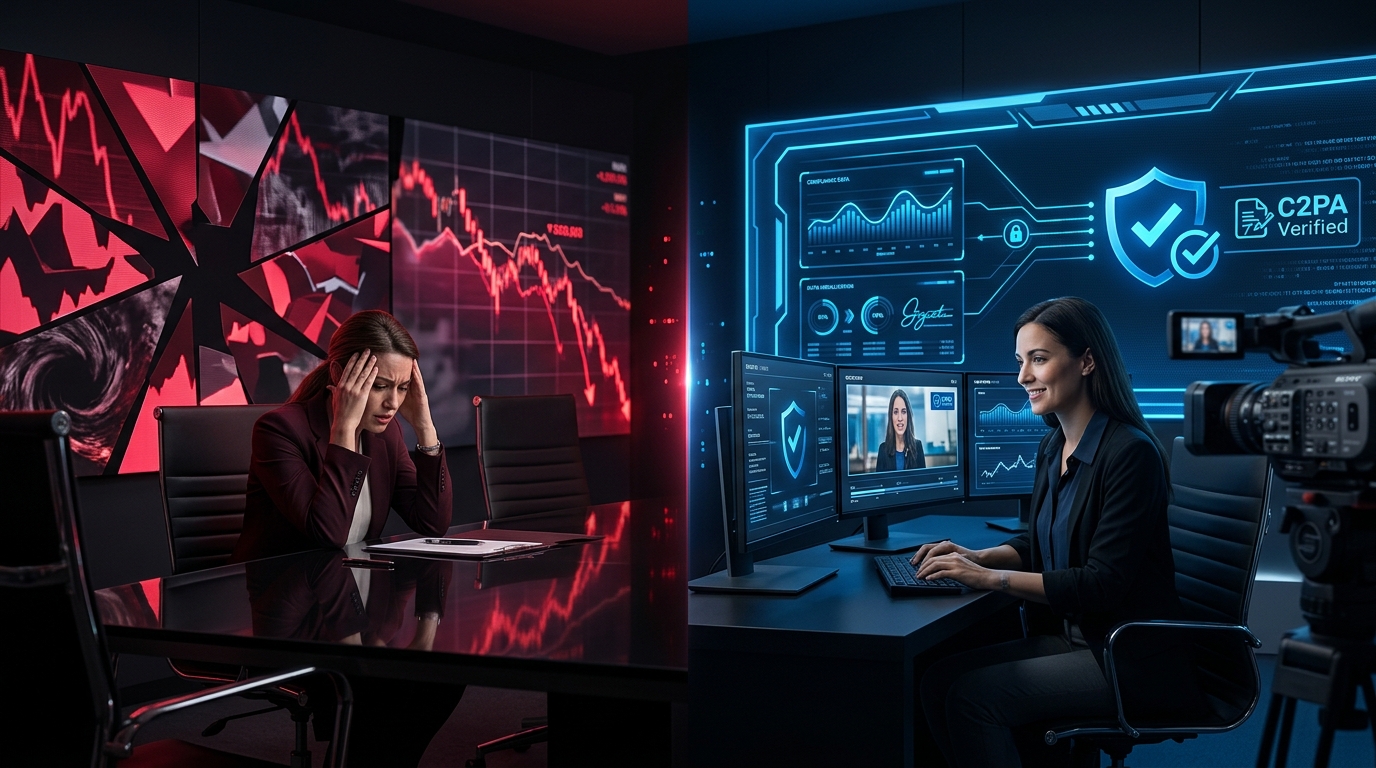
Conversely, investing in digital provenance yields significant savings. Specifically, studios that adopted Content Credentials in early 2025 reported a 40% reduction in legal review times. Because the metadata provides instant verification, legal teams spend less time auditing assets. Additionally, verified content enjoys a 25% higher engagement rate on major platforms in 2026.
Ultimately, the numbers speak for themselves. Unverified synthetic media destroys brand equity overnight. Meanwhile, cryptographic signatures provide an affordable, scalable insurance policy. By proactively adopting these standards, enterprise studios protect their bottom line. Consequently, compliance becomes a competitive advantage rather than a burden.
Visualizing the C2PA Cryptographic Workflow
Understanding the C2PA lifecycle is crucial for enterprise studios. Therefore, let us visualize the journey of a secured video file. First, the process begins at the camera lens. The camera generates an initial manifest and applies cryptographic signatures. Consequently, the raw footage is immediately protected.
Next, the file enters the editing suite. Here, the video editor applies enterprise AI effects. The software records these actions as new assertions. Subsequently, it appends them to the original manifest. This creates a continuous, unbroken chain of digital provenance.
Finally, the studio exports the finished video. The system seals the final manifest using the studio’s PKI certificate. When a viewer watches the video, a small Content Credentials icon appears. Clicking this icon reveals the complete history. Ultimately, this transparent workflow guarantees absolute media integrity from lens to screen.
Conclusion
In conclusion, the EU AI Act has permanently altered video production. Regulators now demand absolute transparency regarding synthetic media. Fortunately, C2PA and Content Credentials offer a robust, standardized solution. By leveraging cryptographic signatures and PKI, studios can easily prove digital provenance.
Ultimately, implementing these tools protects your enterprise from severe legal penalties. Furthermore, it shields your brand from the growing threat of deepfakes. Professional filmmakers must embrace this technology to remain competitive in 2026. Therefore, do not wait for a compliance audit to update your workflows.
Start auditing your video pipelines today. Ensure your editing software supports C2PA metadata natively. By taking action now, you will secure your media integrity for the future. Adopt Content Credentials today, and lead your industry in digital trust.