

Avoid Fines: EU AI Act Compliance for Video Pipelines
Time is officially running out for media companies. Today is July 7, 2026. Next month, a massive regulatory shift will hit the film industry. Therefore, enterprise studios must act now to ensure EU AI Act compliance. The EU AI Act will enforce severe financial penalties for non-compliance. Indeed, fines can completely devastate your production budget.
Managing modern Enterprise Video Pipelines is incredibly complex. Specifically, studios use dozens of machine learning models for editing, VFX, and generation. Consequently, tracking these tools requires immense effort. Without a clear strategy, your studio risks immediate legal exposure. However, you can protect your digital assets. This article provides a comprehensive Compliance Blueprint for your team.
We will break down exactly what professional filmmakers and enterprise content creators must do. First, we will examine the strict new compliance laws. Next, we will explore technical solutions to secure your media workflows. Ultimately, adapting to these rules ensures your studio remains operational and profitable. Furthermore, early adoption will give you a competitive edge.
Understanding the EU AI Act Regulatory Framework
The legal landscape has evolved rapidly over the past two years. First, the EU AI Act officially entered into force on August 1, 2024. According to the European Commission, this established the core rules. Next, lawmakers introduced the Digital Package on Simplification. This package is widely known as the ‘AI Omnibus’ legislative proposal. Consequently, it was officially adopted on November 19, 2025.
This legislative package fundamentally changed how media companies must report their software usage. Furthermore, authorities reached a final political agreement on the ‘AI Omnibus’ amendments on May 7, 2026. Therefore, the regulatory path is fully set in stone. The EU AI Act will become fully applicable on August 2, 2026, with only minor exceptions. As a result, enterprise studios have less than a month to prepare their workflows.

How Transparency Rules Impact Video
The law explicitly categorizes AI systems by their potential risk. Most video generation tools fall under specific transparency obligations. Specifically, the Transparency Rules of the EU AI Act are scheduled to come into effect in August 2026. Therefore, studios must clearly label all synthetic content. Additionally, they must disclose when AI manipulates realistic video footage.
Failure to comply triggers massive, invasive audits. Moreover, hiding the use of deepfake technology is now a serious legal offense. The deepfake panic of early 2026 proved that regulators are aggressively targeting media manipulation. Consequently, enterprise video teams must overhaul their documentation processes immediately. You cannot simply rely on manual tracking anymore. Instead, you need automated, rigorous oversight.
Risk Mitigation and EU AI Act Compliance
Modern filmmaking relies heavily on complex AI tools. For example, editors use AI for automatic rotoscoping, upscaling, and generative fill. However, these fragmented tools create massive legal vulnerabilities. Therefore, Risk Mitigation is now your top operational priority. Ignoring these vulnerabilities will lead to catastrophic production delays.
To survive the upcoming 2026 audits, studios must implement strict provenance tracking. Specifically, integrating C2PA (Coalition for Content Provenance and Authenticity) metadata is absolutely essential. Furthermore, you must track exactly which model generated every single pixel on screen. Consequently, if an auditor questions a specific shot, you must provide instant proof of origin.
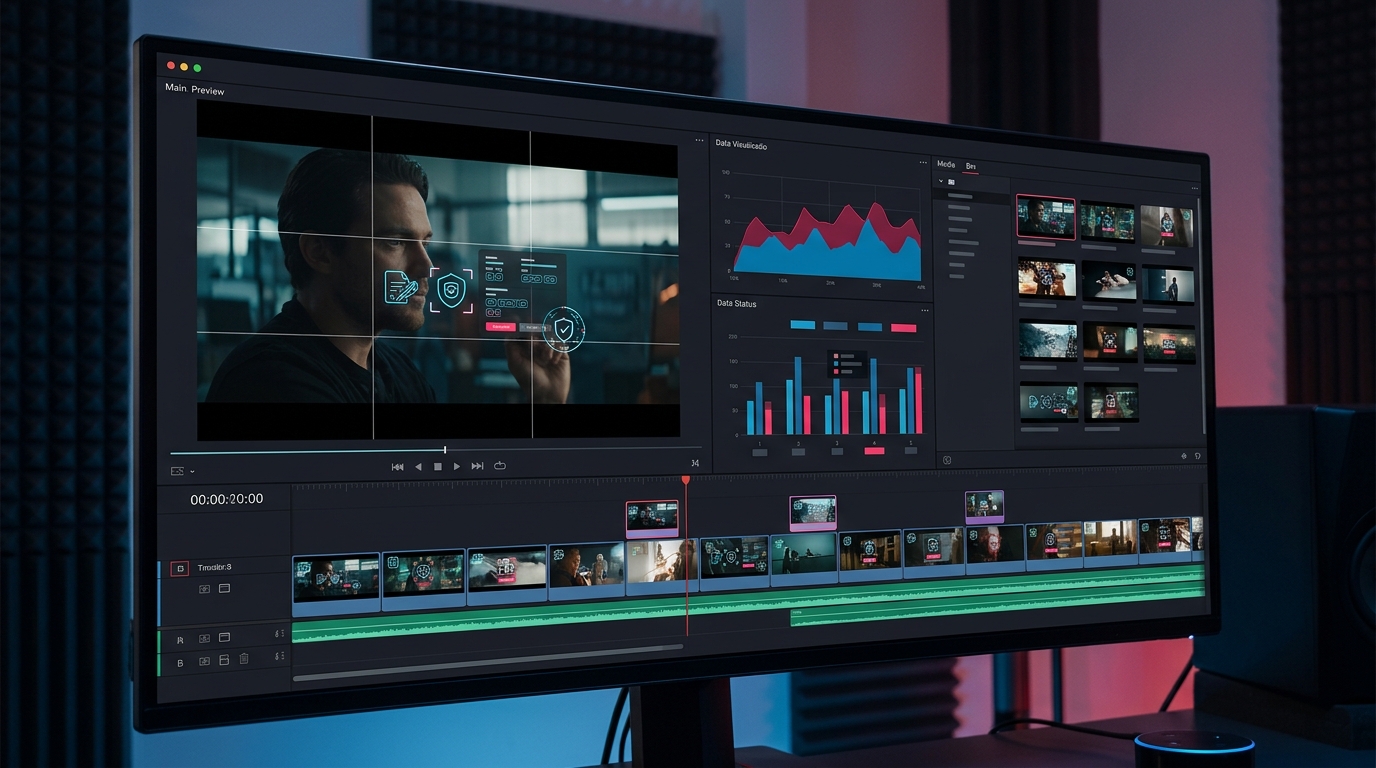
Securing Your Asset Workflows
Enterprise Video Pipelines require a highly structured approach to legal risk. First, you must audit all third-party plugins. Second, verify the training data of any generative models you currently use. Unfortunately, using models trained on copyrighted material directly violates the new regulations. Thus, you must isolate unverified tools from your main production pipeline.
Moreover, establish clear internal guidelines for your creative staff. Your video editors must understand the legal weight of their software choices. Additionally, automate your compliance checks during the final rendering phase. Finally, ensure that your final exports lock in all necessary cryptographic metadata. This proactive approach prevents costly legal battles down the line. Ultimately, a secure pipeline guarantees peace of mind.
Building an AI System of Record for EU AI Act Compliance
Manual spreadsheets cannot handle modern compliance demands. Therefore, studios need a robust AI System of Record. This technology acts as a single, immutable source of truth. Specifically, it tracks every algorithm used in your production environment. Consequently, it guarantees Continuous Compliance across your entire enterprise network.
Many studios mistakenly attempt to use basic tracking tools. However, static registries often fail under scrutiny. This happens because AI deployment is highly distributed. Furthermore, it is incredibly heterogeneous across platforms like MLflow. Thus, a static spreadsheet becomes outdated almost instantly. You need a better solution.
Implementing a Dynamic Model Registry
To meet the strict 2026 standards, you must upgrade your IT infrastructure. EU AI Act compliance requires a continuous, living system of record. Specifically, this system must map every single model, agent, and tool directly to its upstream Data Dependencies. Therefore, if a specific model updates, your registry automatically logs the change.
A dynamic Model Registry actively protects your enterprise. First, it automatically flags any non-compliant tools. Second, it maps the exact data lineage of your video assets. Moreover, it provides instant, formatted reports for EU regulators. Finally, it allows your creative team to focus entirely on making films. Consequently, this technology is a mandatory investment for 2026.
The Financial Impact of EU AI Act Compliance
The financial stakes for the media industry are unprecedented in 2026. Therefore, understanding the hard data is critical for enterprise leaders. Here are the key statistics driving this industry-wide urgency:
- Enforcement Date: The Act becomes fully applicable on August 2, 2026.
- Maximum Fines: Non-compliance can cost up to 35 million EUR. Alternatively, fines can reach 7% of your global annual turnover.
- Adoption Rates: As of early 2026, only 34% of enterprise studios had fully implemented an AI System of Record.
- Audit Readiness: Recent 2026 industry surveys show that 60% of video pipelines fail basic transparency tests.
Consequently, the risk of financial ruin is mathematically high. Furthermore, studios that delay compliance face severe operational bottlenecks. Ultimately, investing in automated compliance software is drastically cheaper than paying EU fines.

Visualizing a Compliant Workflow
Imagine a detailed infographic comparing two distinct studio workflows. On the left side, we see a non-compliant video pipeline. Specifically, it shows chaotic, untracked data flows. Red warning icons highlight disconnected AI upscalers and missing C2PA metadata. Consequently, a large “Audit Failed” stamp covers this entire section.
Conversely, the right side displays a fully compliant pipeline. Here, green arrows connect editing software directly to an AI System of Record. Furthermore, a central Model Registry automatically logs every single Data Dependency. Finally, the finished video file outputs with a secure, verified metadata shield. This visual perfectly illustrates the power of Continuous Compliance.
Conclusion and Next Steps
The August 2026 deadline is no longer a distant threat. It is happening right now. Therefore, enterprise studios must secure their operations immediately. First, you must understand the strict Regulatory Framework. Second, you must apply rigorous Risk Mitigation to your Enterprise Video Pipelines. Finally, you must deploy a living AI System of Record.
Relying on outdated, static tracking will guarantee an audit failure. Moreover, ignoring the Transparency Rules will invite massive financial penalties. However, by adopting a dynamic Model Registry, you protect your studio entirely. Furthermore, you ensure Continuous Compliance without slowing down your creative output.
Do not wait for an audit to expose your vulnerabilities. Instead, audit your Data Dependencies today. Implement your Compliance Blueprint before the end of the month. Ultimately, taking decisive action now will save your enterprise millions. Secure your pipeline, protect your art, and stay ahead of the law.