
The Stagnation of Static Frames
For a long time, the biggest hidden flaw in generative AI filmmaking was the lack of genuine physical movement. Early video models were essentially high-definition image generators that introduced minimal motion—such as slow-moving clouds, a subtle head tilt, or gently falling rain. The moment a creator prompted a complex physical action, like a sprint, a martial arts sequence, or a dramatic camera swoop through a tight space, the underlying algorithms would introduce severe geometric distortion, causing the subjects to melt into a confusing visual mess.
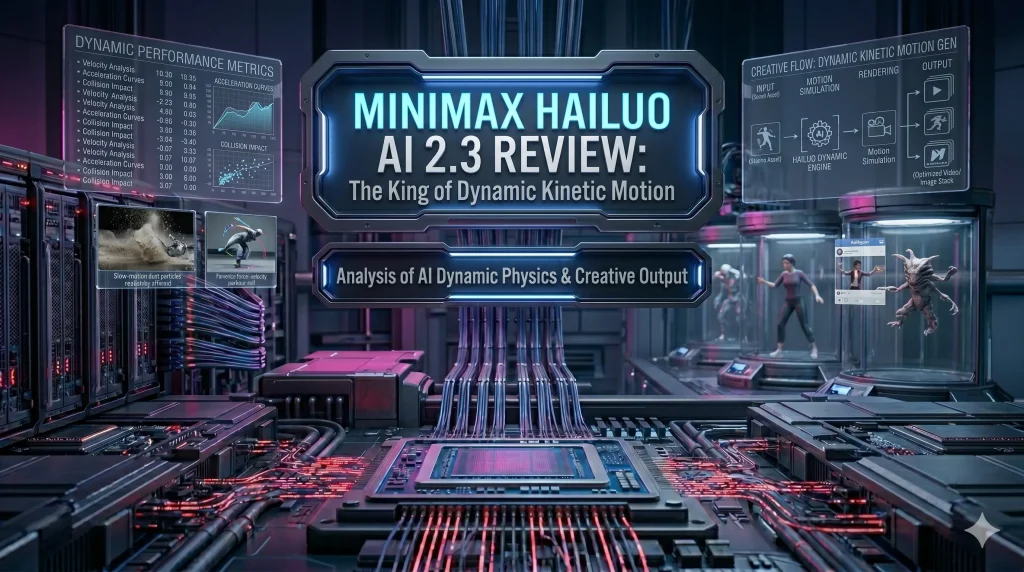
In the mid-2026 production landscape, MiniMax’s Hailuo AI (v2.3) engine has shattered this kinetic limitation.
While heavyweights like OpenAI’s Sora and Google Veo 3 have focused on rendering uncompromised physical photorealism, the engineering teams behind MiniMax have concentrated entirely on Camera Mobility and Complex Physics Processing.
With the deployment of the Hailuo 2.3 architecture, this platform has established itself as the definitive industry tool for high-velocity storytelling, explosive action blocking, and complex physics simulation.
1. The Kinetic Blueprint: Processing Complex Motion Paths
The core breakthrough in Hailuo 2.3 is its ability to handle high-velocity motion without losing object identity or temporal consistency.
True Physical Trajectories
If you input a complex action prompt into Hailuo 2.3—such as a stuntman jumping across a narrow alleyway over a high-contrast Chiaroscuro background—the model does not just slide pixels across the screen. Its algorithm accurately simulates gravity, momentum, and body mechanics.
- The Cinematic Punch: Muscles contract naturally, clothing ripples aggressively to match the wind resistance, and the landing impacts show realistic structural compression.
- Complex Camera Blocking: Hailuo 2.3 excels at processing advanced camera moves like rapid tracking shots, whip pans, and intense 360-degree orbital loops. The background objects shift with perfect mathematical parallax, keeping the entire sequence grounded and clear of the Uncanny Valley.
2. Advanced Control: The Light Studio and Multi-Modal Upgrades
MiniMax has transitioned Hailuo AI from an unpredictable text-prompt playground into a highly controlled, professional creative studio environment.
The Light Studio Upgrade
A major addition to the 2026 Hailuo interface is the Light Studio dashboard. For filmmakers looking to match visual plates with traditional cinema footage, you are no longer limited to basic text descriptors for your lighting setups.
[Base Image/Prompt] ---> (Hailuo 2.3 Light Studio Core)
                                     |
    +--------------------------------+--------------------------------+
    |                                                                 |
[Re-Lighting Angle Vectors]     [Aperture & Bokeh Controls]     [Color Gradient Match]
Through the Light Studio interface, you can drop interactive light source vectors onto your scene, adjust the light temperature (Kelvin scales), and control the depth-of-field blur. The underlying neural network recalculates the shadows and reflections dynamically frame-by-frame, ensuring your lighting profiles look completely organic.
Unprecedented Character Consistency: Subject Reference
Maintaining a single character’s identity across a long sequence used to require hours of post-production masking. Hailuo 2.3 solves this bottleneck with an advanced Subject Reference tool. By uploading a single baseline reference image of an actor, the engine locks their facial structure, hair profile, and clothing design into the model manifest. You can then prompt the character across completely different environmental backbones while maintaining absolute visual identity.
3. MiniMax Open Platform: Developer-First API Pipelining
For software developers, automation experts, and platforms looking to scale their operations, MiniMax provides a highly efficient developer environment via its open platform token plans.
The Scaling Matrix
Unlike consumer dashboards that run on restrictive monthly credit countdowns, MiniMax’s developer API operates on a scalable token system. Because MiniMax recently rolled out massive AI Distillation Updates, the computational footprint of the 2.3 engine has dropped significantly. This distillation means faster render turnaround speeds and lower latency loops, making it an exceptional framework for building automated video generation applications or enterprise content pipelines.
Head-to-Head Technical Performance Matrix
To help your platform visitors select the ideal production engine for their specific content goals, we can evaluate Hailuo 2.3 against top tier industry alternatives:
To discover how to scale the high-velocity outputs of Hailuo 2.3 up to pristine, studio-grade 4K master files, read our comparison guide: Topaz Video AI vs. TensorPix AI: The Ultimate 2026 Upscaling Battle.
| Performance Metric | MiniMax Hailuo AI (v2.3 Series) | OpenAI Sora (2026 Engine) |
| Primary Strength | Dynamic kinetic motion paths and rapid action. | Photorealistic material simulation and real-world physics. |
| Camera Control | Exceptional (Whip pans, orbital loops, high parallax). | Very Good (Smooth cinematic tracks and panning). |
| Control Mechanics | Light Studio Interface + Subject Reference locking. | Text prompting + Core API keyframe anchor matching. |
| Render Efficiency | Blazing fast (AI Distillation delivers ultra-low latency). | Slow/Deliberate (Heavy compute pipeline requirements). |
| Access Model | Standalone Web/App + Open Platform API Tokens. | Managed developer API nodes / Enterprise integration. |
FAQ Section: Mastering Hailuo Production
Q: Can Hailuo 2.3 handle joint audio-visual synthesis natively?
A: Yes. Under the hood, MiniMax pairs the Hailuo 2.3 video model with its advanced Speech audio engines. When you generate a text-to-video clip containing character dialogue, the system automatically builds synchronized vocal tracks and realistic Foley sound effects in a single render pass.
Q: What happens if a generation fails or glitches on the Hailuo web app?
A: MiniMax’s updated 2026 billing infrastructure features a secure validation protocol. If a generation fails due to a system processing error or gets blocked by automated content filters, the consumed credits are instantly returned to your active wallet balance.
Q: Is there a free option available to test MiniMax Hailuo AI 2.3?
A: Yes. MiniMax provides a baseline free tier that grants users daily promotional credits to test standard image-to-video generations. To unlock professional rendering speed, the Light Studio, and advanced Subject Reference features, you can upgrade to their tier-based subscriptions starting at roughly ₹999/month.
To understand the specific compliance parameters and watermarking requirements that apply to these synthetic creations, see our legal guide: The 3-Hour Takedown Rule and IT Amendment 2026 Standards.
Conclusion: The Action Filmmaker’s Verdict
The release of MiniMax Hailuo AI 2.3 has fundamentally changed the rules of generative filmmaking by solving the problem of static AI videos.
If your creative pipeline requires extreme photorealism, perfect texturing, and completely predictable environmental stability, tools like OpenAI Sora or Google Veo 3 remain the top choices.
However, if you are an independent director, a digital agency lead, or a video marketer looking to produce action-packed sequences, complex choreography, high-velocity camera tracking, and character-driven storytelling, Hailuo 2.3 is the undisputed leader in its class. Its unique mix of dynamic kinetic motion and professional lighting controls makes it an essential tool for the next generation of digital media production.