
The Looming Shadow Over Digital Evidence
In the modern courtroom, a video is often treated as an unyielding, objective witness. However, as digital media production tools grow increasingly sophisticated, the line between raw physical reality and synthetic manipulation has blurred into a high-stakes legal gray area. Under the Bharatiya Sakshya Adhiniyam (BSA) 2023, electronic and digital records now hold the identical legal weight of primary paper documents. Yet, this legislative shift brings a massive challenge: How do we prove a video recording genuinely captures reality when pixels are entirely malleable?
The answer does not lie solely within digital code or hash values. Instead, it frequently relies on an ancient artistic principle long utilized by filmmakers: Chiaroscuro—the intentional, high-contrast interplay between light and dark.
For forensic video examiners, defense lawyers, and cinematic creators working within legal spaces, understanding how light physically falls across an environment is becoming the ultimate defense against manipulated, fabricated, or deepfaked evidence. By analyzing shadows, light falloff, and structural luminescence, legal experts can authenticate or completely discredit video evidence introduced in a court of law.
1. The Legal Framework: BSA 2023 and Electronic Records
To understand why visual analysis matters so deeply, we must first look at the updated statutory landscape in India. The transition from the old Indian Evidence Act of 1872 to the Bharatiya Sakshya Adhiniyam (BSA) 2023 fundamentally overhauled how electronic recordings are managed in a trial.
Section 61 and Primary Admissibility
Under Section 61 of the BSA, digital documents—including CCTV footage, smartphone clips, and dashcam videos—are recognized directly as primary evidence, provided they emerge from proper custody and their technical integrity is unchallenged. Furthermore, Section 2(a) of the Bharatiya Nagarik Suraksha Sanhita (BNSS) 2023 explicitly legitimizes “audio-video electronic means” across investigations and judicial trials, demanding videography for police searches and victim statements.
However, primary admissibility does not guarantee ultimate credibility. Because digital evidence is highly prone to malicious tampering or generative alteration, the court must meticulously evaluate its physical and spatial logic before letting it sway a judgment. When a piece of electronic evidence faces allegations of tampering under Section 63 of the BSA, forensic video analysis steps directly into the spotlight.
2. Cinematic Forensics: Reading the Language of Light
When analyzing a suspicious video, a forensic expert reads the frame exactly like a film director or a veteran cinematographer. Every physical space has a distinct environmental signature governed by physics. When bad actors edit, splice, or use generative tools to manipulate video evidence, they almost always fail to accurately replicate how light realistically interacts with physical matter.
The Physics of Chiaroscuro
In traditional cinematography, Chiaroscuro creates volume, depth, and three-dimensional realism on a flat, two-dimensional screen. In a real-world setting, light travels in straight lines and decays over distance according to the inverse-square law. This dynamic produces predictable gradients of light and shadow:
[Light Source] ------> (Physical Object) ------> [Cast Shadow Area]
                          \                         \
                           ---> Highlight            ---> Ambient Falloff
When an object or person is artificially pasted into a scene, or when a face is synthetically swapped via a deepfake algorithm, the light falling across their features rarely matches the ambient lighting profile of the background environment. This creates an immediate physical contradiction that experts can easily isolate.
Analyzing Light Directions and Reflections
Forensic analysts look at three primary indicators to test the structural reality of a video frame:
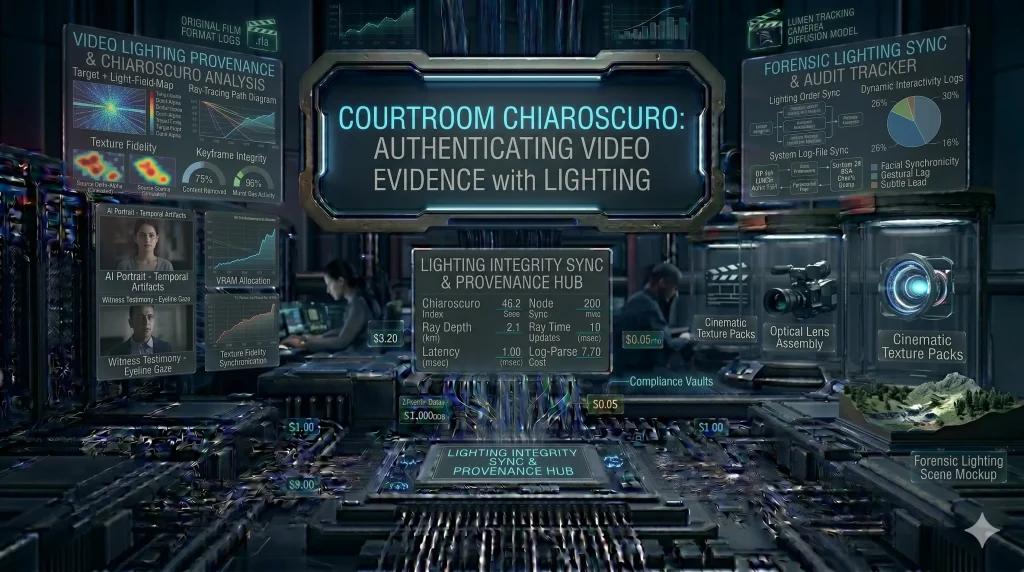
- Specular Highlights (Catchlights): Look closely at a witness’s or suspect’s eyes in a video. The tiny reflections of light sources inside the cornea must perfectly mirror the direction, shape, and intensity of the actual light sources present in the room. If a room features a single overhead bulb, but the eye catchlights show two lateral window reflections, the video has been modified.
- Shadow Cast Alignment: Shadows don’t lie. If a suspect is standing in an outdoor environment, a straight line drawn from the tip of their cast shadow back to the top of their head must point directly to the sun’s position in the sky. If multiple objects in a frame feature intersecting or non-parallel shadow angles under a single unified light source, the structural geometry of the scene is demonstrably false.
- Luminance and Color Bleeding: Light bounces off colored surfaces and subtly transfers that color onto adjacent objects (diffuse reflection). If an individual is standing next to a bright red wall, their clothing and jawline should exhibit a faint red tint. Generative AI tools often fail to calculate this micro-interaction accurately.
3. Isolating Edits via Technical Video Terminology
Beyond macro lighting anomalies, physical edits leave noticeable traces along the structural pacing of a video file. This is where professional cinematic concepts double as critical investigative terminology.
Dissecting J-Cuts, L-Cuts, and Framing Anomalies
In video post-production, a J-Cut occurs when the audio of a subsequent scene cuts in before the visual frame changes, whereas an L-Cut extends a scene’s audio into the following visual segment.
While these transitions are standard narrative tools used to smooth out film storytelling, their unauthorized or undocumented presence inside surveillance footage or evidentiary recordings indicates an “invisible edit.”
Standard Clip:  [--- Audio Track A ---][--- Audio Track B ---]
                [--- Video Track A ---][--- Video Track B ---]

Altered J-Cut:  [--- Audio Track A ---][=== Audio Track B ===]
                [--- Video Track A --------------------------] -> (Delayed Visual Switch)
If the background audio environment (ambient room tone) shifts split-seconds before a physical action occurs on a CCTV feed, it strongly suggests two distinct video segments were spliced together to alter the chronological timeline of events.
The Breakdown of Spatial ‘Blocking’
In theatre and cinema, Blocking refers to the precise physical choreography and positioning of actors relative to the camera and the environment. In a legal context, analyzing the blocking of individuals within a video clip can expose spatial impossibilities.
If a person’s physical volume obscures a background object at an angle that contradicts the camera’s spatial lens profile, it indicates the frame has been composite-edited.
4. Verification & Defense Strategies Under BSA Section 63
When presenting or challenging video evidence in an Indian court under the BSA 2023 framework, legal professionals must maintain a rigid protocol to prove or disprove authenticity.
| Verification Matrix Component | Technical Benchmark | Legal Application (BSA 2023) |
| Hash Value Integrity | SHA-256 or MD5 matching from source to copy | Proves zero data alteration during chain of custody. |
| Geometric Shadow Consistency | Intersecting lines match a singular light source | Rejects composite imagery or added subjects. |
| Photometric Analysis | Consistent pixel luminance across edge boundaries | Flags artificial insertion or deepfake blends. |
| Metadata Provenance | EXIF / Camera original sequence tracking | Satisfies proper custody under Section 63 certificates. |
The Role of the Expert Witness
Under Section 45 of the BSA (corresponding to the old Section 45 of the Indian Evidence Act), courts routinely seek the opinions of examiners to verify digital signatures and electronic records. An expert defense attorney can successfully dismantle a prosecution’s video evidence by demonstrating that the photometric properties of the scene violate basic physical layout rules, rendering the digital record highly untrustworthy.
To master the foundational editing terms mentioned in this guide, read our comprehensive tutorial on How to Use J-Cuts and L-Cuts in Documentaries.
FAQ Section: Understanding Video Admissibility
Q: Can a video be admitted in an Indian court without a Section 63 BSA certificate?
A: No. Under the Bharatiya Sakshya Adhiniyam, a valid legal certificate validating the proper custody, operation of the device, and integrity of the electronic record is a mandatory prerequisite for admitting secondary electronic records into evidence.
Q: How does generative AI complicate video forensics in 2026?
A: Generative AI tools can create highly realistic environments, but they struggle with consistent geometric lighting over extended sequences. Temporal inconsistencies—where shadow sharpness or lighting angles fluctuate across frames—are prime indicators of synthetic generation.
Q: What is the ‘Uncanny Valley’ effect in legal video forensics?
A: It refers to the subtle psychological discomfort viewers feel when looking at a near-perfect human replica generated by AI. In forensics, this is verified by tracking micro-expressions, lack of natural blinking, or mismatched pixel boundaries around facial contours.
Conclusion: Crafting Your Legal-Tech Content Strategy
For creators and professionals building an authoritative presence on a legal-cinematic platform, analyzing the intersection of cinematography and jurisprudence is highly lucrative. It establishes a powerful level of E-E-A-T that search engines actively prioritize, ensuring your digital media asset captures premium search visibility.
If you want to configure your production rig to capture legally sound, uncompromised footage, review our Best Camera and Audio Setups for Legal Compliance.