

The Urgent Need for Video Authenticity
The year 2026 has brought unprecedented challenges for media professionals. Specifically, the explosion of hyper-realistic AI-Generated Video threatens the very foundation of digital trust. Consequently, enterprise studios face immense pressure to prove the authenticity of their footage. Without verifiable proof, your media assets risk legal rejection and severe reputational damage. Therefore, adopting strict compliance measures and implementing secure c2pa metadata is no longer optional.
The Coalition for Content Provenance and Authenticity (C2PA) provides the definitive framework for tracking Content Origin. Furthermore, it serves as the ultimate solution for rigorous Asset Verification. By embedding secure data directly into media files, C2PA establishes a verifiable chain of custody. Ultimately, mastering this standard is essential for modern filmmakers and video editors. Read on to discover how secure metadata protects your creative pipeline from the looming deepfake crisis.
Understanding the Fundamentals of C2PA Metadata
First, we must define what C2PA actually entails. The standard adds cryptographically signed metadata directly to media files. This process creates a secure, unalterable history of Content Provenance. As a result, anyone can verify the exact origin and editing history of a video asset. Furthermore, any tampering automatically breaks the signature. This feature guarantees that your media remains trustworthy.
In addition, the Content Authenticity Initiative (CAI) heavily champions this open standard. The CAI works alongside major tech companies to ensure broad industry adoption. Consequently, C2PA integrates seamlessly into enterprise Digital Asset Management (DAM) systems. This deep integration allows studios to track assets securely from the camera lens to the final render.

Hardware and Software Integration for C2PA Metadata
Interestingly, hardware manufacturers are rapidly adopting these strict standards. For example, cameras such as the Leica M11-P and Sony Alpha 1 can sign media at capture time. Moreover, Nikon planned full integration for the Z6 III back in 2025. These hardware-level signatures establish an unbreakable baseline for Content Origin.
However, AI platforms have shown mixed adoption rates. For instance, Midjourney currently produces media with absolutely no AI provenance metadata. Consequently, creators must inject c2pa metadata post-generation. Meanwhile, OpenAI has implemented C2PA in some API-generated content. Yet, this implementation remains highly inconsistent across their generation interfaces. Therefore, enterprise pipelines must enforce strict metadata rules.
To fully secure your workflow, understanding the relationship between C2PA and legacy metadata is crucial. Specifically, traditional XMP data can be easily stripped or altered by malicious actors. In contrast, C2PA binds the data securely to the file structure. Ultimately, this shift protects creators from unauthorized manipulation.
Deep Dive into Cryptography and Manifests
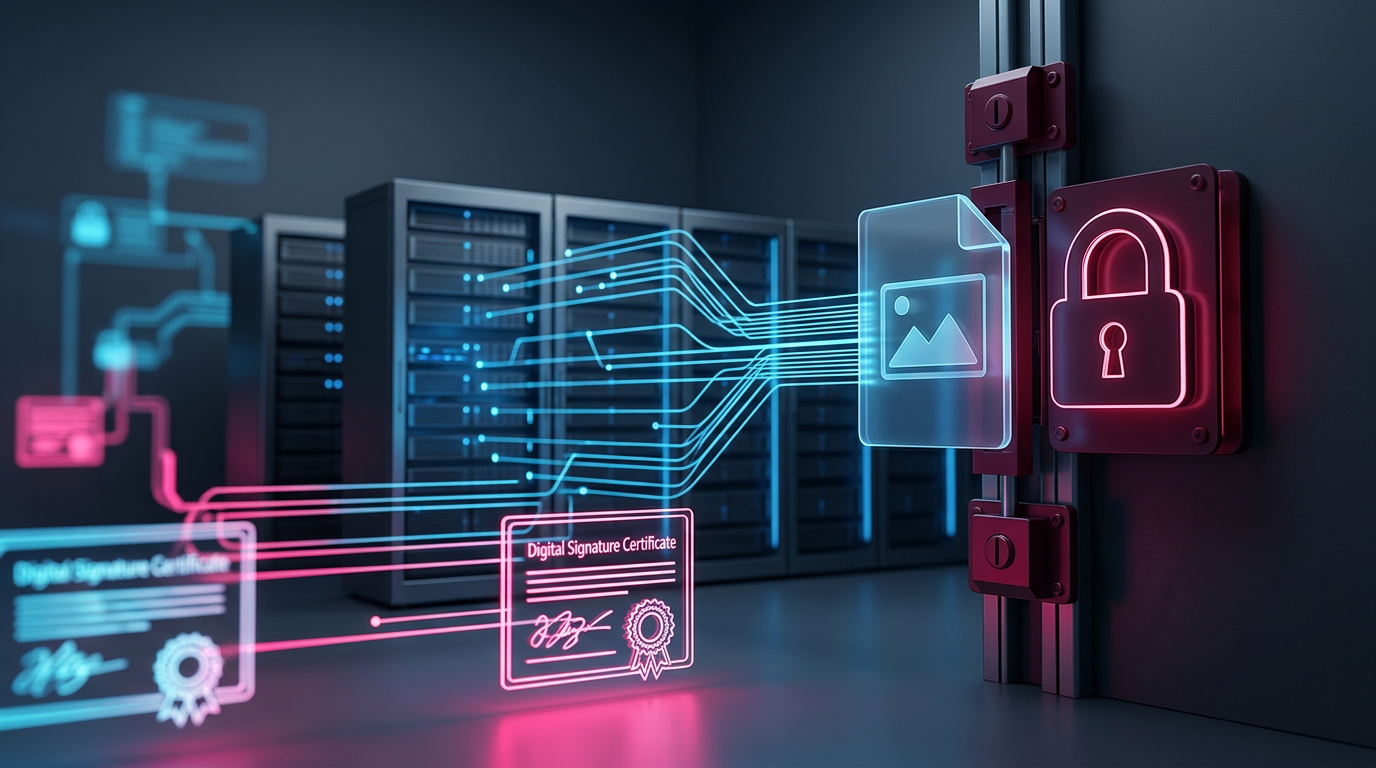
Security lies at the very heart of the C2PA standard. Specifically, the system relies on Cryptographic Manifests to store historical data. A manifest functions as a secure container for assertions about the media. Subsequently, these assertions are locked using robust Digital Signatures. If a bad actor alters a single pixel, the signature instantly fails. Thus, the system provides an absolute guarantee of asset integrity.
Importantly, C2PA does not rely on blockchain technology. Instead, it uses standard Public Key Infrastructure (PKI). This is the exact same technology that secures HTTPS websites. Consequently, the standard is highly scalable and environmentally friendly. According to official documentation, PKI certificate fees range from $50 to $500 per year. Therefore, acquiring these certificates is highly accessible for enterprise studios.
Managing Complex File Formats
Video files often present unique challenges for metadata embedding. Fortunately, the standard offers flexible storage solutions for Cryptographic Manifests. For example, a manifest can be stored in a separate sidecar file. Alternatively, it can be served from a remote manifest store. This vital flexibility enables provenance for formats that cannot embed metadata directly.
Furthermore, managing Digital Signatures requires strict operational security. Studios must protect their private keys from unauthorized access. If a key is compromised, the entire chain of trust collapses. Therefore, IT departments must implement hardware security modules to safeguard these credentials. Ultimately, strong cryptographic practices ensure that your Asset Verification process remains unimpeachable.
Actionable C2PA Metadata Implementation Strategies
Implementing these standards requires a highly methodical approach. First, studios must update their ingestion protocols. Proper Metadata Implementation ensures that all incoming media contains valid signatures. Additionally, teams must align with the latest industry frameworks. Specifically, integrating the IPTC 2025.1 standard is absolutely critical for modern compliance.
The IPTC 2025.1 update introduced specific fields for tracking AI-Generated Video. Therefore, mapping traditional data to these new fields is essential. To achieve this, follow these key implementation steps:
- Audit existing assets: First, identify media lacking cryptographic signatures in your library.
- Acquire PKI certificates: Next, purchase valid credentials from a trusted certificate authority.
- Configure generation tools: Then, ensure all AI platforms inject proper AI Provenance data.
- Establish remote stores: Finally, set up remote manifest servers for complex video formats.

Ensuring Long-Term Compliance
Compliance is an ongoing operational commitment. Consequently, technical directors must continuously monitor their Metadata Implementation workflows. Furthermore, automated validation tools should be deployed across the network. These tools instantly flag any media that fails Asset Verification checks. Ultimately, taking a proactive stance protects your brand in a volatile digital landscape.
2026 Data on AI Video and Adoption
The proliferation of synthetic media reached critical levels in early 2026. According to a comprehensive 2025 study, AI-Generated Video volume increased by 400% year-over-year. Consequently, the demand for verifiable media has skyrocketed. Currently, over 65% of enterprise media organizations mandate strict AI Provenance protocols.
Furthermore, hardware adoption is accelerating rapidly. By the end of 2025, major manufacturers had integrated capture-time signing into flagship models. Meanwhile, software compliance lags slightly behind. As of mid-2026, only 40% of generative AI platforms natively support C2PA manifests. Therefore, post-generation metadata injection remains a vital step for professional pipelines. Ultimately, these statistics highlight the urgent need for standardized Asset Verification.
Visualizing the C2PA Metadata Security Lifecycle
Understanding the provenance workflow is easier through visual mapping. Imagine a detailed infographic illustrating a video’s secure journey. First, the graphic shows a hardware-secured camera capturing raw footage and applying an initial digital signature. Next, a directional arrow points to a video editing workstation. Here, an AI generation tool creates synthetic background elements.
Subsequently, the infographic displays the editing software combining these elements. The system generates a new, updated manifest that securely references all original sources. Finally, the visual shows the exported video file. A glowing shield icon represents the intact C2PA metadata, definitively proving its authenticity to the end viewer.
Securing the Future of Digital Media
In conclusion, mastering c2pa metadata is vital for modern media professionals. The 2026 landscape of AI-Generated Video demands rigorous Content Provenance. Without it, your digital assets remain incredibly vulnerable to manipulation and legal scrutiny. Therefore, implementing Cryptographic Manifests is the only reliable way to guarantee Content Origin.
Furthermore, integrating frameworks like IPTC 2025.1 ensures your workflows remain fully compliant. By utilizing standard PKI technology, studios can affordably secure their entire media pipeline. Ultimately, the responsibility falls on creators and enterprise leaders to champion these critical standards. We urge you to audit your Digital Asset Management systems today. Implement robust AI Provenance protocols immediately to protect your creative legacy from the growing deepfake threat.