
The Deceptive Headline Price
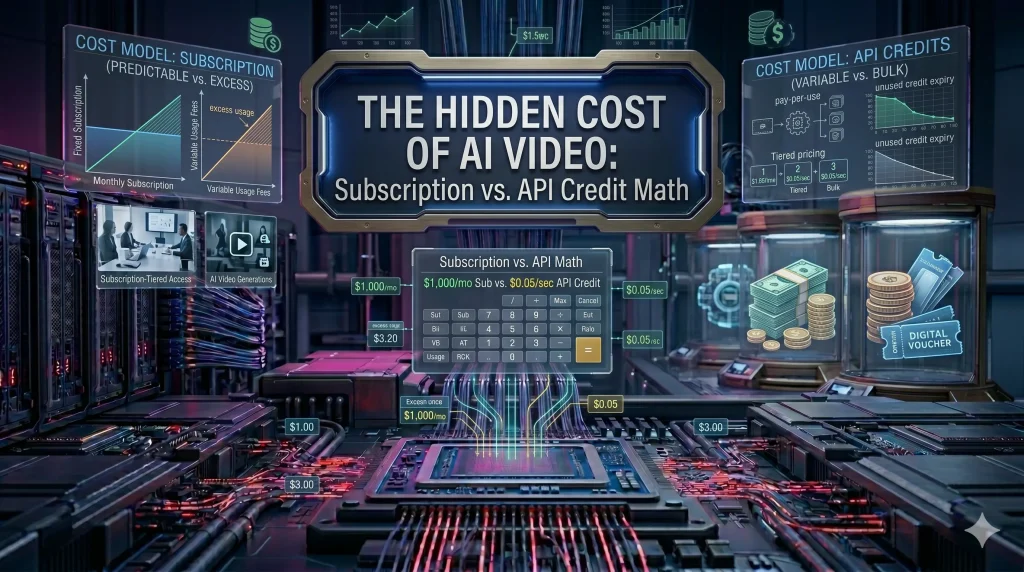
When you visit the pricing page of a modern generative video platform, the financial barrier to entry appears incredibly low. Mainstream cloud-based suites frequently advertise starter subscription packages ranging from $10 to $30 a month, promising hundreds or even thousands of “monthly credits.” To a creator or digital agency lead planning a production budget, this sounds like a massive supply of cheap, high-end footage.
However, once you enter a real-world production environment, that baseline subscription tier can completely vanish within a single afternoon of editing.
In 2026, the generative video ecosystem operates on a highly complex financial framework. Factors like Professional quality rendering toggles, joint audio-visual synthesis multipliers, and high-definition resolution scaling scales act as hidden cost drivers.
For platforms like bestaivideotools.com, providing an honest, math-driven breakdown of Subscription Credits vs. Pay-Per-Second API billing is essential for establishing deep E-E-A-T authority and guiding creators toward the most cost-effective production paths.
1. The Subscription Model Trap: Credit Multipliers and Forced Burning
To evaluate why baseline plans are deceptive, we must look at how credit systems are structured. Platforms like Kling AI give users a fixed monthly allowance (e.g., 660 credits on a standard $10 plan). However, a single click on a button can radically change how many credits a clip actually consumes.
The Professional Mode Penalty
Most subscription networks use “Standard Mode” rendering as their baseline price reference. A standard 5-second video typically burns a modest 10 credits.
However, Standard Mode frequently introduces visual artifacts, dropped frames, and anomalies that drop the clip straight into the Uncanny Valley. To get footage sharp enough for commercial monetization, creators must toggle Professional Mode, which instantly jumps the price to 35 credits per 5 seconds.
The Native Audio Multiplier
The integration of joint audio-visual synthesis—where high-fidelity dialogue lip-syncing or custom Foley sound design is rendered natively alongside the video track—introduces another financial layer.
Generating video with synchronized, automated sound layers can consume up to 5x more credits than creating silent footage. On an entry-level plan, a single 10-second high-quality audio-visual generation can burn roughly 200 credits, reducing your monthly output capacity to just three usable video attempts.
[Silent Standard Video (5s)]  ---> Consumes: 10 Credits  (Cheap / Draft Quality)
[Pro Mode + Native Audio (5s)] ---> Consumes: 70+ Credits (Premium / Production Ready)
2. The API Pay-Per-Second Model: High Costs with Infinite Control
For enterprise developers, software automation hubs, and production agencies that require batch rendering tools without subscription queues, the Application Programming Interface (API) is the standard solution.
Instead of dealing with abstract credits that reset each month, official developer pipelines (like the OpenAI API) charge directly based on a Flat Cost Per Second of Output.
Breaking Down the OpenAI Sora API Rates
The official developer pricing scales sharply based on resolution and model tier, making duration management a critical skill:
- sora-2 (720p Baseline): Billed at a flat $0.10 per second. A 10-second social media clip costs exactly $1.00.
- sora-2-pro (720p Studio Tier): Billed at $0.30 per second. A 10-second high-fidelity sequence jumps to $3.00.
- sora-2-pro (1080p Full HD Master): Billed at a premium $0.70 per second. A 10-second horizontal master plate costs $7.00, meaning a single minute of high-definition generation runs a steep $42.00.
While these API rates are significantly more expensive than consumer subscription models, they offer two massive advantages: Zero monthly credit expiration limits and unlimited rate limits across high-tier developer accounts.
3. The Hidden Loss Vector: Failed Render Rejections
The single largest unadvertised expense in generative media production is the cost of trial and error. AI generation is fundamentally unpredictable; achieving a perfect visual clip that maintains exact Temporal Continuity and accurate Chiaroscuro lighting alignment often requires three to five independent generation passes.
The No-Refund Policy
On standard cloud subscription tiers, if an AI model encounters a mid-render glitch, introduces a melting anatomical distortion, or gets rejected by an automated content moderation filter after processing begins, those credits are gone forever.
If an agency spends 500 credits across ten variations to get a single usable 10-second shot, the actual cost of that asset isn’t the advertised $0.20 baseline—it has spiked to a real-world cost of $2.00.
Subscription vs. API Financial Audit Matrix
To assist your readers in selecting the most financially sound architecture for their business model, we can compare both processing tracks side-by-side:
| Cost Metric Dimension | Cloud Subscription Tiers (e.g., Kling Pro) | Developer API Architecture (e.g., Sora API) |
| Primary Billing System | Monthly/Annual fixed subscription costs. | Pay-as-you-go billing based on exact output length. |
| Credit Expiration Rules | Resets to zero at every billing cycle (No Rollover). | Pre-paid funds remain active for 90 days to 2 years. |
| 10-Second 1080p Cost | Included in monthly allocation (~$0.15–$0.50/clip). | Scaled strictly by tier ($1.00 base up to $7.00 Pro HD). |
| Failed Render Cost | Hard loss (Credits are consumed regardless of quality). | Mixed (Official APIs charge per second; proxies offer failure protection). |
| Best Operational Fit | Agile solo creators, daily vertical social media assets. | Enterprise platforms, software automation, batch systems. |
To discover how to scale raw, lower-resolution AI clips up to flawless commercial 4K files without burning premium high-tier API credits, read our matchup guide: Topaz Video AI vs. TensorPix AI: The Ultimate 2026 Upscaling Battle.
FAQ Section: Optimizing Your Creative Budget
Q: Is there any way to prevent losing credits on failed AI generations?
A: While official subscription dashboards rarely offer refunds for poor output quality, some advanced developer reverse-proxy networks (like laozhang.ai) provide specialized API access routes featuring strict no-charge-on-failure policies. If a generation fails mid-pass or triggers a content moderation block, your account balance remains untouched.
Q: What is “Relaxed Mode” on high-end AI subscription tiers?
A: Premium plans (such as ChatGPT Pro at $200/Month) frequently feature an unlimited “Relaxed Mode.” Once you exhaust your fast priority credits, your renders are queued behind active premium accounts. This processing shift means generations take longer to complete, but it allows you to render heavy batch files overnight at zero marginal cost.
Q: Do top-up credit packs expire at the end of the month?
A: No. Unlike recurring monthly subscription credits, standalone top-up credit packages purchased through your dashboard dashboard typically carry an extended validation life, remaining active for up to two full years. A smart budget strategy is to use your base subscription credits for daily drafts, and deploy top-up packs for temporary high-volume client projects.
Conclusion: Balancing Efficiency and Financial Freedom
Navigating the financial layer of generative video production requires looking past surface-level marketing numbers and executing cold, data-driven cost analysis. Subscription tiers remain the most predictable option for independent creators pushing out daily vertical content assets. However, for software developers, large design agencies, and enterprise networks that require automation, paying a premium for direct API seconds provides unmatched control.
By analyzing credit multipliers, resolution tiers, and failure rates systematically, you protect your business from sudden operational bottlenecks, ensuring your digital publication scales into a lean, highly profitable media asset.
To see how these budgeting structures match a sustainable long-term corporate growth strategy, see our detailed operational breakdown: The 12-Month Roadmap: Building a Legal-Cinematic Media Empire.