
Introduction: The Unseen Architect of Perception
When an audience watches a documentary, an investigative report, or a video-recorded deposition, they believe they are reacting entirely to the words spoken by the witness on screen. In reality, their emotional state, level of trust, and psychological engagement are being quietly directed by an unseen architect: the video editor.
In the realm of Cinematographic Mastery, editing is far more than just slicing together a sequence of clean clips. It is the management of time, tension, and human vulnerability.
When presenting heavy, emotionally exhausting, or dense legal testimony, a raw, unedited sequence of “talking head” shots can quickly lead to cognitive fatigue for the viewer. Conversely, over-editing or using rapid, flashy transitions completely destroys the authenticity and credibility of the subject, sending the video straight into the “uncanny valley” of over-manufactured media.
To maintain absolute credibility while keeping the audience engaged, creators and editors must look to advanced auditory and visual transition techniques—specifically the strategic deployment of J-Cuts and L-Cuts. By mastering the delicate pacing of dialogue, breath, and silence, filmmakers can humanize technical testimony on screen, ensuring it resonates with viewers while preserving its fundamental truth.
1. Anatomy of the Split-Cut: J-Cuts vs. L-Cuts
At the core of professional narrative pacing is the concept of the split-cut (or L-cut/J-cut). In standard, low-tier video editing, audio and video cuts happen at the exact same frame (a straight cut). Straight cuts are jarring and unnatural because human beings do not experience the world that way. When you are in a room and someone starts talking behind you, your ears register the sound before your eyes turn to look at them.
Split-cuts replicate this natural human sensory experience by separating the audio transition from the video transition.
The Mechanics of the J-Cut
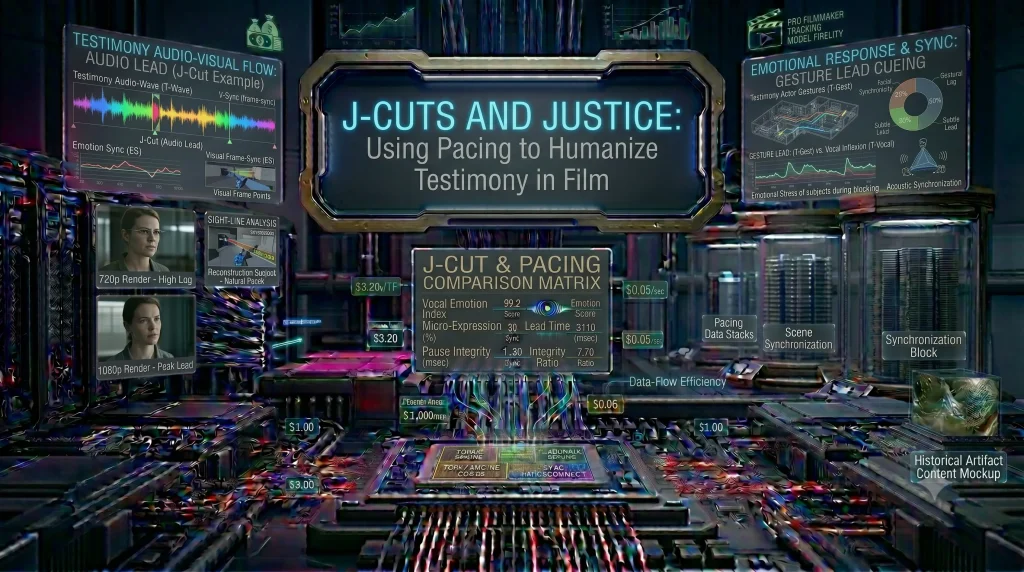
A J-Cut is an editing structure where the audio of the upcoming clip (Clip B) begins playing while the viewer is still looking at the visual elements of the current clip (Clip A). It gets its name because the media blocks on an editing timeline resemble the letter “J”.
Visual Timeline:  [------ Visual Clip A ------][------ Visual Clip B ------]
Audio Timeline:   [--- Audio A ---][=========== Audio Clip B ===========]
                                   ^
                           (Audio enters early)
In the context of testimony or interview films, a J-Cut is exceptionally powerful for introducing a witness or transitioning to a critical piece of corroborative B-roll footage. Hearing a witness’s voice tremble or catch before cutting to their face allows the viewer to prepare emotionally, drawing them deeper into the person’s internal headspace.
The Mechanics of the L-Cut
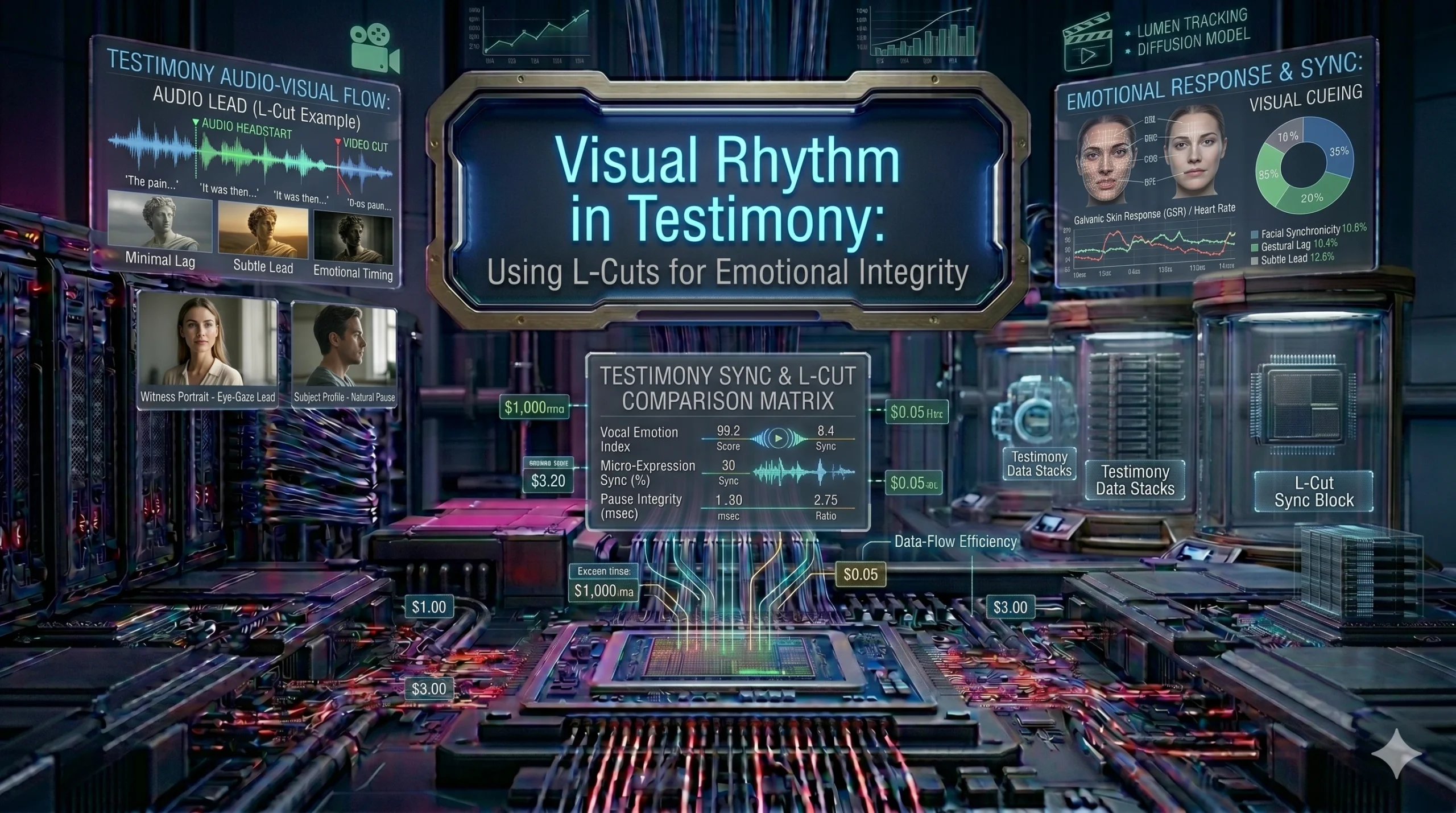
Conversely, an L-Cut occurs when the visual track transitions to a new clip (Clip B), but the audio from the previous clip (Clip A) continues to play underneath the new visuals. The timeline configuration here takes the shape of the letter “L”.
Visual Timeline:  [------ Visual Clip A ------][------ Visual Clip B ------]
Audio Timeline:   [====================== Audio Clip A ==================][--- Audio B ---]
                                               ^
                                    (Audio trails underneath)
L-cuts are invaluable when a witness is describing an event, an object, or a crime scene. By maintaining the witness’s voice while cutting away to show a high-contrast close-up or drone shot of the location, the editor binds the human emotion of the speaker directly to the physical environment being discussed.
2. The Narrative Rhythm of Human Vulnerability
When editing legal or documentary testimony, the absolute worst mistake an editor can make is removing the natural pauses, stammers, and inhalations of the speaker. Modern automated “jump-cut” tools designed for hyperactive social media feeds are engineered to delete silence entirely. While this works for fast-paced tech reviews, it completely strips testimony of its emotional weight and psychological truth.
The Architecture of a Pause
Silence is not empty space; it is a communication tool. When a witness is asked a challenging, deeply personal, or legally complex question, the time it takes for them to answer tells a story.
- The Immediate Response: Can signal absolute certainty or rehearsed preparation.
- The Delayed Response: Communicates deep reflection, emotional pain, or internal conflict.
By preserving these beats, the editor allows the viewer to witness the human brain actively processing memory. Cutting away from a witness’s face using an L-cut during a long, heavy pause to show a still photograph or a detail shot of their tightly clenched hands communicates an immense narrative layer without changing a single word of the transcript.
3. Pacing Framework for Complex Testimony
To help content strategists and cinematic editors manage complex multi-hour recordings, we can map out an optimal narrative pacing structure. This framework balances technical legal delivery with deep emotional accessibility.
| Pacing Phase | Narrative Intent | Primary Editing Technique | Target Visual Framing |
| Phase 1: Establishing Context | Introduce the witness, build baseline credibility, and settle the audience. | Straight Cuts transitioning into gentle J-Cuts to smooth out standard introductory questions. | Medium wide shot, neutral ambient lighting, balanced framing. |
| Phase 2: Rising Tension | Delve into core conflicts, technical cross-examinations, or memory recall. | Tight J-Cuts to speed up conversational rhythm; introduce tight B-roll overlays via L-Cuts. | Medium close-up, highlighting subtle shifts in posture or gaze. |
| Phase 3: The Climax Beat | High-emotion statements, critical revelations, or major turning points. | Zero Cut Silence. Hold on the raw visual frame. Absolutely no B-roll or musical score intervention. | Extreme close-up. Focus entirely on the eyes and mouth to maximize raw human connection. |
| Phase 4: Resolution / Cool-Down | Reflecting on long-term consequences and summarizing the core message. | Long, trailing L-Cuts where the voice continues over ambient environmental footage as the scene fades out. | Wide establishing shot or atmospheric environmental landscape. |
4. Ethical Guardrails: Narrative Flow vs. Material Distortions
Because split-cuts, B-roll overlays, and pacing adjustments possess immense power to influence user perception, they must be governed by a strict code of creative ethics. In an era where platforms demand high E-E-A-T scores, maintaining editorial integrity is crucial for long-term brand equity.
- The Context Preservation Rule: You may use J-cuts and L-cuts to seamlessly remove verbal filler words (like “um,” “ah,” or “you know”) to make a long testimony easier to follow. However, you must never splice together entirely different answers to alter the underlying meaning of the witness’s statements.
- B-Roll Accuracy: When cutting away from a speaker to present supportive visual materials, ensure those visuals are contextually accurate to the events being discussed. Introducing highly dramatic, unrelated, or artificially exaggerated B-roll underneath an objective statement crosses the line from helpful presentation into emotional manipulation.
- Auditory Continuity: Ensure that the underlying background environment sound remains completely consistent during split-cuts. A sudden drop in ambient noise during a J-cut instantly flags to both the viewer’s subconscious and automated audio authentication tools that the timeline has been artificially modified.
To discover how visual lighting structures complement these auditory transition techniques, read our masterclass on Courtroom Chiaroscuro: Authenticating Video Evidence with Lighting.
FAQ Section: Optimizing Video Transitions
Q: Why do straight cuts feel so jarring when editing dialogue sequences?
A: Straight cuts force the brain to process a simultaneous shift in both visual data and audio tracking. Split-cuts (like J-cuts) ease this cognitive load by easing the viewer into the next space through audio, which matches how humans naturally shift their attention in the physical world.
Q: Can using too many J-cuts hurt the pacing of a video documentary?
A: Yes. If every single cut uses a J-cut, the editing rhythm becomes highly repetitive and predictable. Use them strategically—specifically when entering a new line of questioning, introducing a new voice, or moving into an emotionally heavy sequence.
Q: Does professional video editing style affect AdSense and SEO metrics?
A: Absolutely. High-quality editing increases User Engagement Time and Retention Rates on your embedded video channels. When users spend more time consuming your content without bouncing off the page, search engines interpret your site as a high-value resource, raising your programmatic ad tier.
Conclusion: Elevating Media with Structural Intent
Mastering the balance between J-cuts and narrative pacing transforms raw, unpolished video recordings into a gripping, professional asset. By using cinematography and post-production techniques to respect human pacing rather than fighting against it, you elevate the authority of your content. For creators expanding their digital footprint on platforms like bestaivideotools.com, demonstrating an expert understanding of these cinematic systems builds an unbreakable bond of trust with your audience, positioning your network at the absolute pinnacle of your chosen niche.
To ensure your legal documentary work remains fully compliant with the latest synthetic media guidelines, review our analysis on The 3-Hour Takedown Rule and IT Amendment 2026 Compliance Standards.