
Editing Beyond the Words
When an audience watches a high-stakes deposition, a historical documentary interview, or an investigative news package, they subconsciously look for signs of psychological truth. They watch for shifts in eye direction, changes in posture, and moments of hesitation. While a script or a text transcript captures what was said, it completely fails to capture how it felt to say it.
In the toolkit of Cinematographic Mastery, the video editor acts as a dynamic guide for human empathy.
When a witness or an interview subject delivers emotionally heavy testimony, relying entirely on simple straight cuts—where the video and audio tracks switch at the exact same millisecond—creates a rigid, robotic rhythm. This abrupt style breaks the visual flow, distances the audience, and can subtly make a genuine human interaction look over-manufactured and artificial.
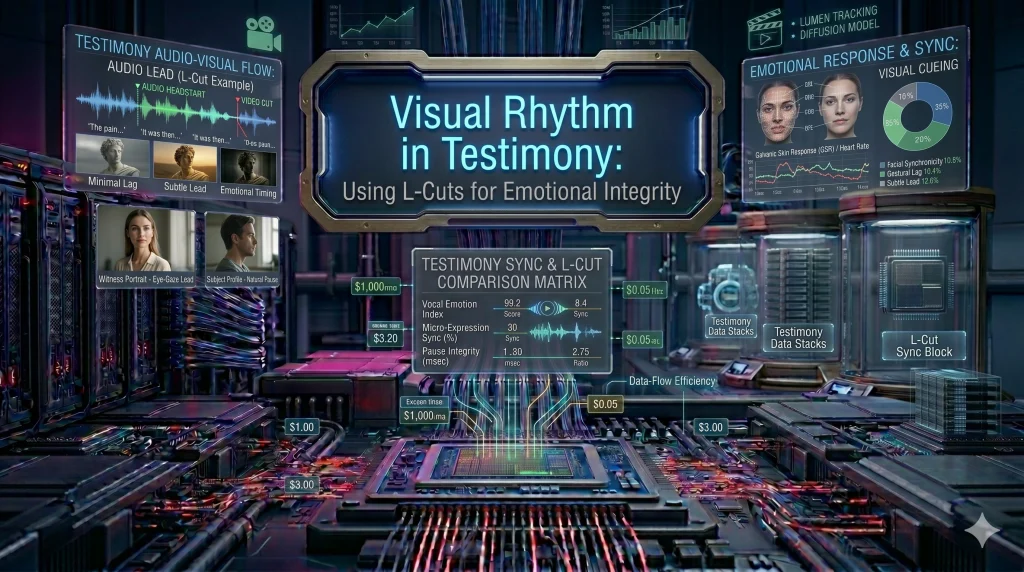
To preserve the raw, emotional truth of an interview, professional editors use advanced split-cutting techniques, specifically the L-Cut. By decoupling visual pacing from audio continuity, filmmakers can capture the delicate visual rhythm of human memory, ensuring a testimony resonates with viewers while protecting its absolute authenticity.
1. The Anatomy of Sensory Layering: How the L-Cut Operates
To understand why split cuts feel so seamless to a viewer, we must look at how humans naturally process sensory information. In our daily lives, we rarely experience simultaneous shifts in sound and vision. If you are listening to someone speak and they point toward an object across the room, your eyes naturally glance at that object while their voice continues to trail in your ears.
An L-Cut replicates this exact human sensory experience within an editing software timeline.
The Structural Blueprint of the L-Cut
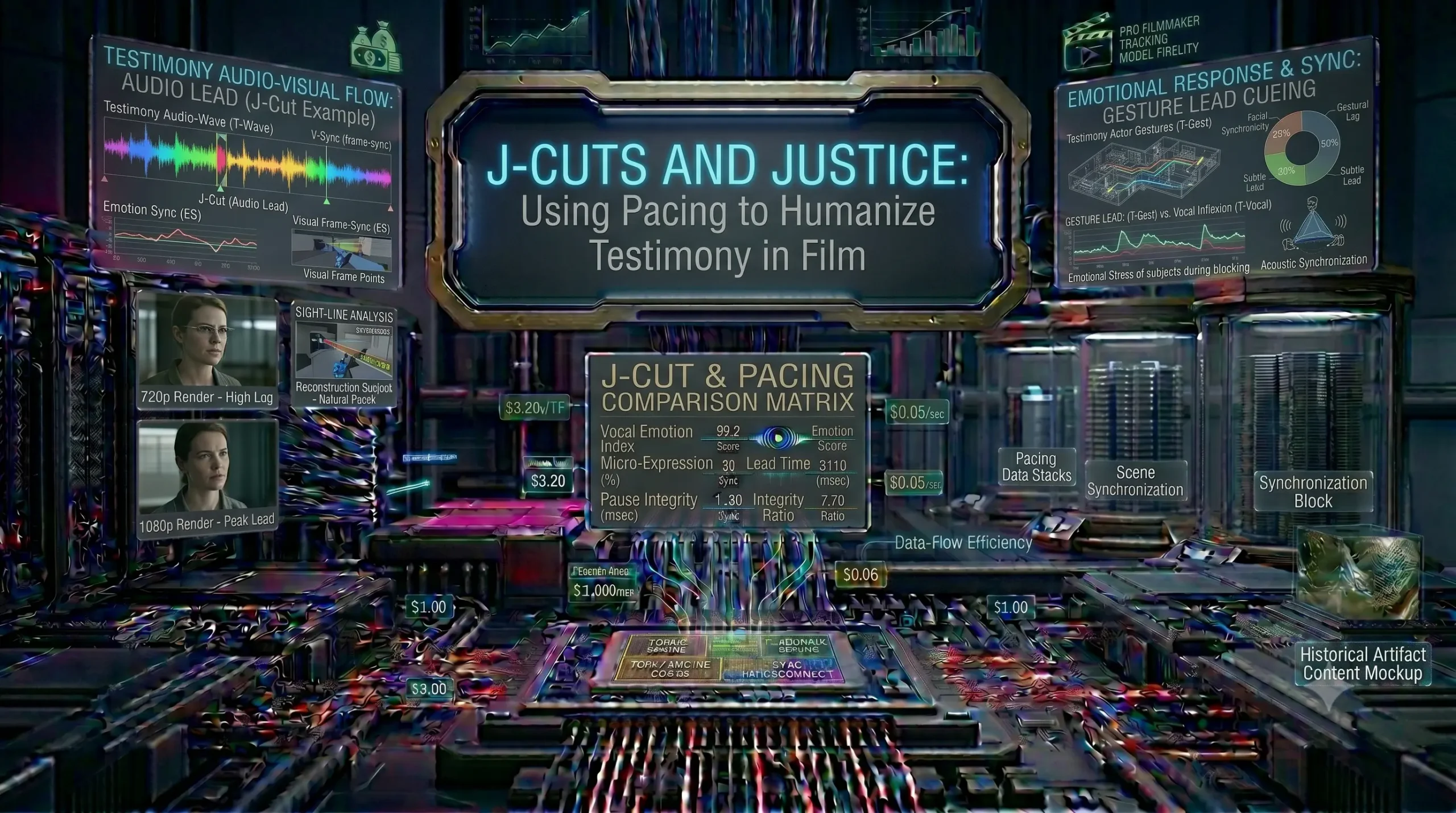
Technically, an L-Cut occurs when the visual track cuts away to a new piece of footage (Clip B, typically relevant B-roll or a different camera angle), but the audio track from the previous shot (Clip A, the speaker’s voice) continues to play underneath the new visuals. On an editing timeline, the overlapping tracks physically form the letter “L.”
Visual Timeline:  [------ Visual Clip A (Speaker) ------][------ Visual Clip B (B-Roll) ------]
Audio Timeline:   [======================== Audio Clip A (Speaker) ======================][--- Audio B ---]
                                                         ^
                                            (Audio trails under new visuals)
By allowing the speaker’s voice to trail beneath supportive contextual imagery, you maintain narrative continuity. The audience remains connected to the speaker’s train of thought, even while their eyes are evaluating new visual information.
2. Managing the Visual Rhythm of Trauma and Memory
When editing intense, personal, or complex testimony, an editor must manage the cadence of human speech. Traditional commercial video production values prioritize speed, frequently scrubbing out quiet pauses, deep breaths, and vocal stammers to keep things moving. In documentary and legal filmmaking, however, deleting these quiet moments strips away human vulnerability.
The Power of the Trailing Audio Tail
Consider a sequence where an interview subject finishes a deeply painful sentence and then stops speaking to collect themselves, staring silently into the distance.
- The Straight Cut Trap: Slicing the clip the instant the final word ends and cutting immediately to a wide shot or a question from the interviewer. This abrupt transition destroys the emotional weight of the moment, making the edit look cold and unsympathetic.
- The L-Cut Solution: When the subject stops speaking, hold their final vocal breath or the quiet room tone on the audio track while cutting the visuals away to a slow, high-contrast close-up of their hands tightly gripping a chair, or a relevant Chiaroscuro shot of the room.
This specific pacing allows the audience to sit with the weight of the words. It lets viewers absorb the emotional gravity of the statement without forcing them to stare uncomfortably at a vulnerable person’s face during a private moment of grief.
3. The Pacing Matrix: Balancing Sound and Sight
To help content strategists, documentary filmmakers, and post-production houses manage long, complex recordings smoothly, we can map out a targeted pacing matrix based on emotional intent:
| Narrative Context | Emotional Objective | Visual Action | Audio Action |
| Technical Explanations | Establish clear, logical understanding and build baseline credibility. | Cut cleanly to explanatory graphics or data documents. | Maintain a continuous, smooth vocal track under the graphics using gentle L-Cuts. |
| Sudden Revelations | Create sharp emotional focus, surprise, or intense viewer engagement. | Hold a tight, locked close-up shot on the witness’s face and eyes. | Zero cut processing. Keep the audio and video locked to show the raw reaction frames. |
| Deep Personal Reflection | Humanize the subject, communicate pain, or show internal memory recall. | Cut away to a slow-panning, evocative environmental landscape or B-roll plate. | Allow the subject’s trailing sigh, deep breath, or hesitant pause to play underneath the visuals. |
| Transitioning Topics | Signal a clear change in thematic focus and reset the audience’s attention. | Move to a wide establishing shot or an atmospheric transitional card. | Introduce a subtle shift in the background Foley or ambient room tone slightly ahead of the cut. |
4. Ethical Standards for Creative Post-Production
Because split-cutting and visual layering possess immense power to shape user perception and guide emotional response, they must be governed by a strict code of creative ethics. Showing a high level of editorial integrity is vital for maintaining an ad-safe domain that satisfies search engine evaluation metrics.
- Preserve the Original Emotion: You can use an L-Cut to mask an awkward camera adjustment or cover an accidental frame skip. However, you must never overlay a sad, trailing voice segment onto unrelated B-roll to artificially manufacture an emotional state that the subject did not genuinely manifest during the interview.
- Maintain Environmental Sound Continuity: When extending an audio track underneath a new visual layer, ensure the underlying background room tone remains completely consistent. A sudden, sharp silence or a jump in ambient audio values during an L-cut instantly signals a clumsy edit to the viewer’s ear, shattering the illusion of reality.
- Prioritize Context Over Flash: Every B-roll asset laid over a speaker’s voice must add legitimate contextual value to their words. Avoid using overly dramatic, generic, or sensationalized stock footage simply to keep the screen moving. If a piece of visual media doesn’t directly support the truth of the statement, trust the strength of your subject and hold the frame on their face.
To discover how to combine these auditory transition patterns with traditional visual lighting setups, see our masterclass on Courtroom Chiaroscuro: Authenticating Video Evidence with Lighting.
FAQ Section: Perfecting Dialogue Transitions
Q: When should I choose a J-Cut over an L-Cut during an interview workflow?
A: Choose a J-Cut when you want to smoothly introduce a new voice or prepare the audience for an emotional shift before showing the speaker on screen. Choose an L-Cut when you want to emphasize the lingering impact of a spoken statement by trailing the person’s voice over a supportive visual image or context shot.
Q: Can excessive split-cutting damage the credibility of a documentary video?
A: Yes. If every single line of dialogue uses a J-cut or an L-cut, the editing rhythm becomes highly hyperactive and predictable, which can make the film look over-produced. Use straight cuts for standard, back-and-forth conversational dialogue, and save split-cuts for major emotional transitions, thematic shifts, or introductions.
Q: Do these advanced editing techniques affect my website’s Google AdSense performance?
A: Highly polished, emotionally engaging editing directly improves Audience Retention Metrics and extends Average On-Page Session Durations for users watching your embedded videos. When visitors spend more time engaging with your content rather than leaving immediately, ad networks classify your site as a premium domain, which raises your programmatic ad revenue tiers over time.
Conclusion: Honoring the Human Element in Film
Mastering the use of L-cuts and dialogue pacing transforms a standard, static interview video into an immersive cinematic experience. By designing your edits to mirror how humans naturally listen and process memory, you respect both the dignity of your subject and the intelligence of your audience. For digital content publishers scaling authority platforms like bestaivideotools.com, demonstrating a deep understanding of these professional post-production techniques builds incredible trust with your audience, securing your platform’s position as a premium resource for digital media excellence.
To see how to align your creative production values with a profitable commercial growth plan, review our comprehensive 12-Month Roadmap: Building a Legal-Cinematic Media Empire.