
Introduction: The Soundscape of Truth
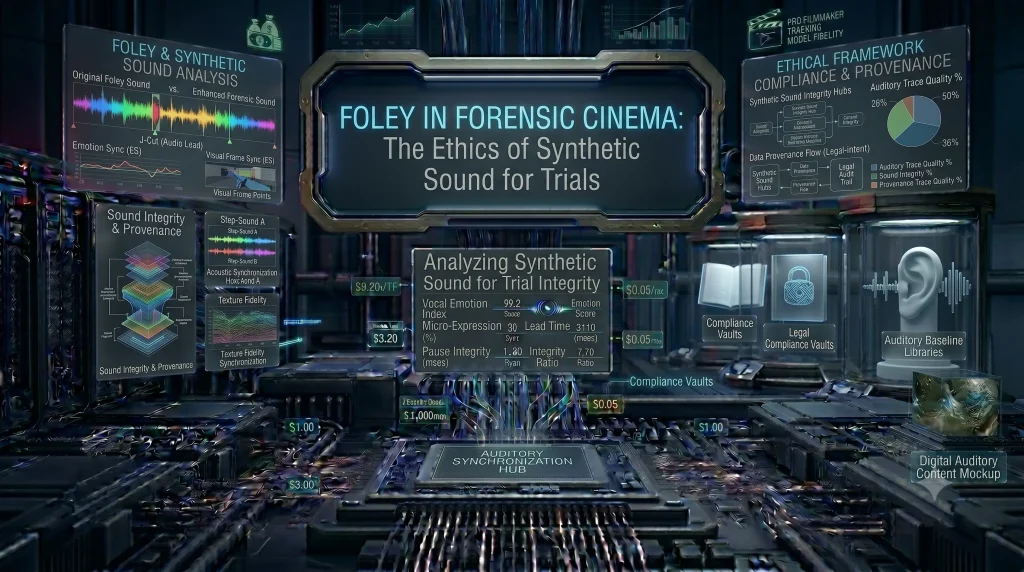
When we watch a video recording, our eyes intuitively search for structural alterations, visual glitches, or lighting discrepancies. However, human perception is deeply multimodal; what we hear dictates how we interpret what we see. In a cinematic masterclass, Foley—the art of reproducing and recording everyday sound effects to overlay onto video—is the invisible force that creates spatial depth, emotional resonance, and environmental realism.
But what happens when the tools of cinematic storytelling are introduced into a court of law?
In 2026, the rise of generative AI sound models allows anyone to synthesize hyper-realistic Foley sound design from simple text prompts. A silent surveillance tape or a low-quality smartphone video can be augmented with crisp footsteps, the distinct metallic click of a weapon, or ambient environmental room tones.
While these tools offer immense potential for legal video re-enactments and crime scene reconstructions, they present an unprecedented ethical and forensic hazard.
Under the Bharatiya Sakshya Adhiniyam (BSA) 2023, the modification of an evidentiary audio track—even if executed in good faith to improve clarity—stretches the legal definition of data integrity. For legal-tech creators and forensic examiners, understanding the boundaries of synthetic sound engineering is no longer an artistic luxury; it is a strict requirement for preserving the chain of custody.
1. The Acoustic Architecture of Foley Sound Design
To evaluate whether an audio track has been artificially altered with synthetic Foley, one must understand how sound functions as a physical, spatial asset. In professional cinematography, Foley is divided into three primary categories:
- Footsteps: The texture, timing, and resonance of an individual moving through an environment.
- Movements (Sfx): The subtle rustle of clothing, the handling of objects, or the acoustic shift of physical contact.
- Specifics: Custom impacts, structural drops, or environmental mechanics.
In a physical space, every sound wave is shaped by its acoustic environment. The dimensions of the room, the materials of the walls (concrete, wood, or glass), and the distance between the sound source and the microphone create a unique signature called the Impulse Response (IR).
When an editor uses an AI tool to generate synthetic Foley effects—such as adding a distinct “thud” to match a physical fall on screen—the AI frequently generates an “acoustically clean” sound wave. Even if the editor attempts to match the room’s reverb, the synthetic sound wave lacks the micro-level acoustic reflections that occur naturally. Forensic audio analysis can isolate these clean waves, revealing that the audio was injected post-capture.
2. Legal Admissibility Under BSA 2023: Section 39 and Beyond
The introduction of synthetic or augmented audio into an Indian courtroom is regulated by strict statutory guardrails. The legal system must ensure that the audio track is a true reflection of the physical event, rather than an artistic interpretation.
Section 39 BSA: Relevancy of Statements in Electronic Records
Under Section 39 of the Bharatiya Sakshya Adhiniyam 2023, when any statement or evidence is contained within an electronic record, the court demands that only the portion which is highly relevant, unaltered, and structurally continuous be evaluated.
If a video contains an audio track where the visual layer is original, but the audio layer has been enhanced using AI-generated Foley to “clarify” what happened, the entire electronic record faces immediate disqualification. The law views the addition of synthetic audio elements as an unauthenticated alteration of a primary record.
The Problem of the “Invisible Edit”
In creative post-production, sound designers routinely use J-Cuts and L-Cuts to smooth transitions. In a legal documentary, this adds narrative flow. In a forensic investigation, however, a J-Cut in the audio track is highly problematic.
If the ambient sound of a room shifts split-seconds before a physical event occurs on screen, it implies that an external audio asset was laid over the timeline. Under cross-examination, this structural mismatch allows opposing counsel to argue that the record has been compromised under Section 63 of the BSA.
3. Forensic Detection: How Experts Unmask Synthetic Audio
Forensic audio examiners use advanced tools to separate natural environmental recordings from synthetically generated or enhanced sound layers.
Phase Inversion and Spectral Analysis
Every natural audio recording contains a baseline acoustic signature known as Room Tone. This is the collective sound of an “empty” environment—microscopic air currents, distant electrical hums, and structural vibrations.
When synthetic Foley is mixed into an existing track, the underlying room tone is inevitably disrupted. Analysts use a process called Spectral Subtraction and Phase Inversion to isolate the added sound waves. If the phase profile of a footstep sound does not exhibit the identical low-frequency room noise as the surrounding silence, it is flagged as a post-production insertion.
Original Audio Track:  [--- Room Tone Baseline ---][--- Natural Impact ---]
                                                     (Consistent Frequency)

Altered Audio Track:   [--- Room Tone Baseline ---][=== AI Foley Insertion ===]
                                                     (Disrupted Phase Signature)
The Verification Matrix for Evidentiary Sound
To evaluate the authenticity of an audio-visual asset before it is submitted to a judicial body or a public platform, examiners use a structured verification framework:
| Forensic Vector | Natural Audio Characteristic | Synthetic/AI Foley Indicator |
| Acoustic Coherence | Consistent Impulse Response matching the room’s geometry. | Echo and reverb profiles that violate physical wall placement. |
| Spectral Continuity | Seamless, uninterrupted background room tone. | Sudden micro-drops or clean patches in the frequency spectrum. |
| Sync Alignment | Perfect physical correlation between impact frames and sound waves. | Imprecise alignment or unnaturally sharp transients that bypass lens depth. |
| Metadata Profile | Unbroken codec stream with consistent write-speed values. | Re-encoded file architecture showing software signatures. |
4. Ethical Guidelines for Legal-Tech Content Creators
If you are a digital content strategist, website manager, or video creator producing material for legal-tech hubs, corporate compliance portfolios, or investigative documentaries, you must navigate these boundaries carefully.
- Maintain Strict Bifurcation: If you use generative AI tools to reconstruct a crime scene for educational or illustrative purposes, clearly label the video throughout its playback. The title card must state: “Synthetically Enhanced Reconstruction – For Illustrative Purposes Only.”
- Preserve the Raw Asset: Never perform destructive edits on the original media container. Always work on a secondary duplicate track, ensuring the original metadata and hash profiles (SHA-256) remain uncompromised.
- Disclose AI Enhancement: In alignment with the IT Amendment Rules 2026, if an audio-visual asset contains more than minimal AI audio processing, embed clear provenance markers into the file container to retain absolute platform transparency.
To understand the legal penalties associated with digital media manipulation, read our deep dive on Digital Crimes Under BNS 2023: A Cinematic Creator’s Guide.
FAQ Section: Navigating Forensic Audio Law
Q: Is it legal to use AI software to remove background noise from a witness interview recording?
A: Yes, provided the process is purely subtractive. Using AI-driven noise suppression to eliminate wind or traffic noise is generally acceptable under the good-faith editing exemptions of the IT Rules 2026. However, adding sound elements to fill the resulting silence is strictly prohibited.
Q: What is the penalty for submitting falsified audio evidence in an Indian court under the BNS 2023?
A: Fabricating electronic records to influence a judicial proceeding carries severe criminal penalties under the Bharatiya Nyaya Sanhita (BNS) 2023, including imprisonment and heavy fines for perjury and tampering with public justice.
Q: Can automated tools reliably detect AI-generated voice clones and Foley?
A: While advanced algorithmic models can identify synthetic voice artifacts by checking high-frequency harmonic structures, detection tools are not entirely foolproof. Comprehensive forensic authentication still relies on human experts checking the physical and spatial logic of the sound file.
Conclusion: Balancing Creative Power and Truth
As generative media creation tools become more powerful, the responsibility of the creator shifts from purely aesthetic execution to rigorous ethical verification. Foley sound design remains a brilliant vehicle for immersive cinematic storytelling. However, when applied to real-world disputes, investigative journalism, or legal-tech documentation, it must be governed by an absolute commitment to structural truth. By maintaining clear boundaries between creative enhancement and factual preservation, you protect your platform’s long-term authority and secure a highly trusted position within your niche.
To ensure your platform complies with watermark regulations for mixed media, see our comprehensive compliance tracker on The 3-Hour Takedown Rule and IT Amendment 2026 Compliance.