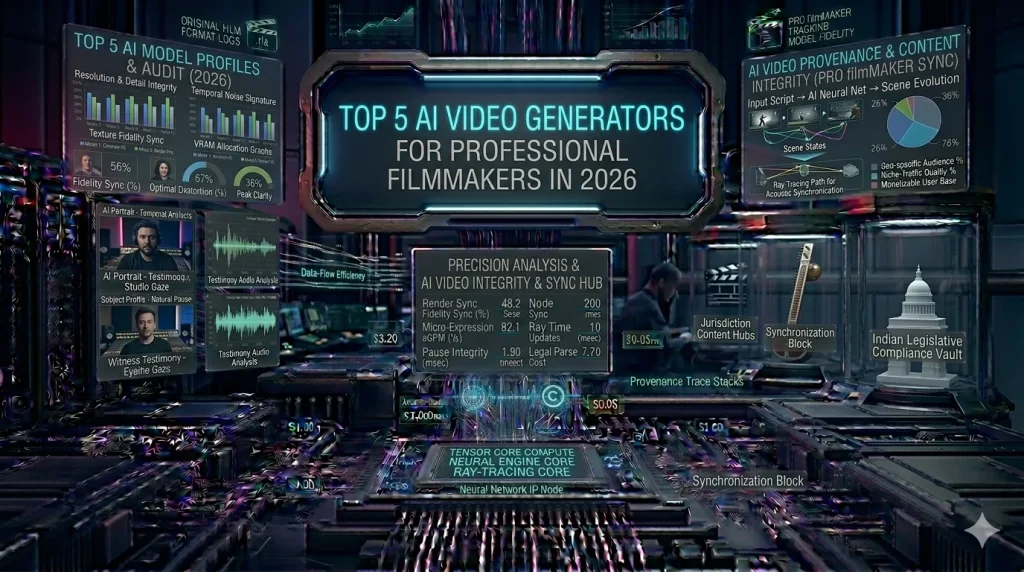

The landscape of digital cinema has shifted. In 2026, we are no longer asking if AI can be used in filmmaking, but which tool provides the most realistic physics, character consistency, and synchronized audio. For professional creators, the goal isn’t to replace the camera but to expand what is possible within a limited budget.
Whether you are looking to generate a cinematic “rain sequence” or need a high-fidelity background for a classical dance performance, these five AI video generators are leading the industry this year.
1. Google Veo 3.1: The Cinematic Gold Standard
Google’s Veo 3.1 remains the most reliable tool for filmmakers who prioritize prompt comprehension and high-end aesthetics. It stands out in 2026 as the first major model to successfully integrate native, synchronized audio directly into the generation process.
- Best For: Creating atmospheric, high-fidelity clips with realistic dialogue and ambient soundscapes.
- Key Feature: Cinematic physics that respect lighting and shadows, making it ideal for “mood-heavy” scenes.
2. OpenAI Sora 2: Narrative Mastery
After a long-awaited release, Sora 2 has redefined narrative video. While the early versions were criticized for erratic camera movements, Sora 2 excels at complex human motion and 20-second “story-driven” clips.
- Best For: Scenes involving complex protagonist movements, such as dance or intense action sequences.
- Pro-Tip: Use Sora 2 when you need a video that follows a specific, detailed narrative script.
3. Runway Gen-4: The Professional’s Choice
Runway continues to be the industry standard for Character Consistency. If you are building a film where the same character needs to appear in multiple different shots, Runway’s “Reference Image” system is unmatched.
- Best For: Commercial productions and multi-scene projects where visual continuity is non-negotiable.
- Key Feature: Advanced camera controls (pan, tilt, zoom) that give the director total precision over the AI’s “lens.”
4. Luma Dream Machine (Ray 2): The Physics King
If your filmmaking style relies on realistic motion and high-energy camera work, Luma Dream Machine is the tool to watch. Its “Ray 2” architecture was trained with ten times the computational power of previous models, resulting in fluid, natural-looking physics.
- Best For: Fast-paced social media content and brainstorming realistic “b-roll” shots.
- Why It Works: It generates 120 frames in record time, making it the fastest tool for quick iterations.
5. Kling AI 2.6: The Volume Secret Weapon
For creators who need high-quality output without a Hollywood budget, Kling AI has become the go-to “scrappy” competitor. It produces impressively long clips (up to 2 minutes in some modes) at a fraction of the cost of its peers.
- Best For: VFX-heavy scenes and creators who need a high volume of clips for long-form content.
- Key Feature: The ability to add specific “Start” and “End” images to guide the AI’s movement perfectly.
Conclusion: Choosing Your Creative Partner
In 2026, the best AI tool is the one that respects your creative vision. For cinematic detail, go with Veo. For character consistency, stick with Runway. As a creator, your job is to use these tools to enhance the “human” element of your storytelling—because at the end of the day, a film needs a soul to truly resonate.
In my next post, I’ll show you How to Monetize a Creative Portfolio using these very tools.